
How Martha Washington Coins Paved the Way for Modern Coinage
Did you know Martha Washington helped shape the coins in your pocket? Or that she’s one of the few historical women to grace both U.S. coins and paper money?
In fact, Mrs. Washington is arguably among the most featured figures in U.S. currency.
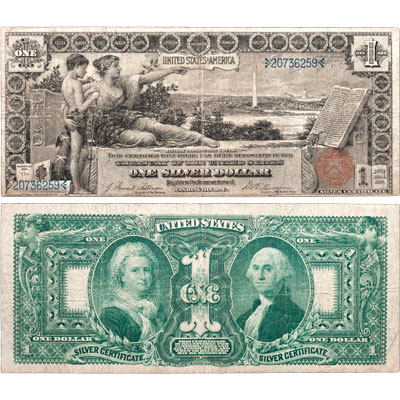
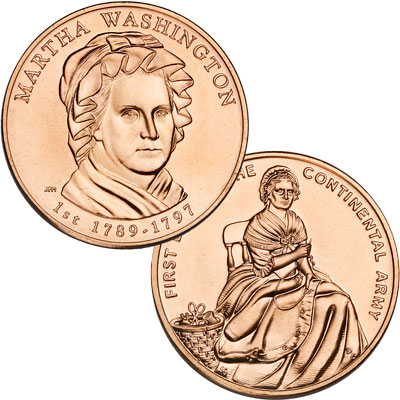
Her portrait has graced the 2007 Martha Washington First Spouse medal and $10 gold coin. As well as three different Silver Certificates – including the acclaimed 1896 “Educational Series” $1 note.
And while other women, such as Pocahontas, have appeared in vignettes on American currency notes, Martha holds the distinction of being the first – and to date, the only – historical woman whose portrait has graced regular-issue U.S. federal paper money.
But these are just a few of the numismatic tributes to America’s inaugural First Lady.
Legend has it the U.S. Mint’s first official coin – the 1792 half dime – also bears Mrs. Washington’s likeness. Although experts now believe the coin actually depicts Liberty.
Include pattern and experimental strikes, and the number of Martha Washington coins and notes jumps significantly. Because she’s been featured on at least six more U.S. denominations and sizes: the cent, nickel, dime, quarter, half dollar and dollar.
So let’s step behind the scenes at the U.S. Mint, where Martha Washington’s portrait has played a unique role in helping develop our national coinage. But first…
What Is a Pattern Coin?
Before we look further at Martha Washington coins, it helps to know what pattern coins are. In simple terms, they are test coins – experimental strikes produced by the mint to test new designs, die pairings, metal compositions, planchet materials, etc.
Even new denominations.
Mint technicians use pattern coins to evaluate how a proposed coin will perform under real-world conditions – how it strikes, how quickly it wears, etc. And in modern times, whether it works in vending machines.
Of course, it wouldn’t do for these test pieces to be mistaken for actual currency. So the mint makes sure they’re easy to recognize by their unique or “nonsense” designs and inscriptions.
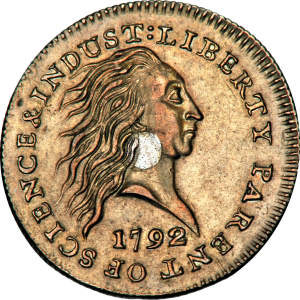
Famous early examples of U.S. pattern coins include the 1792 Birch cent, with its Liberty Head portrait and simple yet striking “liberty parent of science & industry” legend.
Another well-known case is the Gobrecht dollar of 1836 to 1839, which was struck while the mint explored resuming silver dollar production. Like the 1792 half dime, the Gobrecht dollar saw limited circulation – blurring the line between experimental and practical coinage.
The Gobrecht dollar’s obverse would go on to grace six different denominations: the Liberty Seated half dimes, twenty-cent pieces, quarters, half dollars and dollars. While its eye-catching Flying Eagle’s reverse would later be featured on America’s first small cent.
Over the years, these coins have become prized and sought-after pieces. They offer a fascinating window into the evolution of American coinage, showing the careful research and testing that goes on behind the scenes before new coins reach the public.
Many of the finest examples reside in the Smithsonian’s National Numismatic Collection, one of the world’s largest and most important numismatic research collections.
An Experimental Coinage Legacy
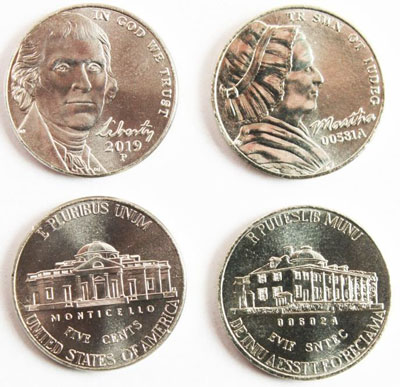
Photo Credit: U.S. Mint
The mint routinely tests new alloys and compositions, and not just to help offset rising production costs. It also tests them to solve supply chain issues and to make it harder to counterfeit U.S. coins.
Those tests are sometimes conducted with regular dies. But many use nonsense dies. And while the reverses may vary, the obverses often feature the mint’s favorite First Lady: Martha Washington.
Martha Dandridge Custis Washington – “Patsy” to her close family – helped define the role of First Lady. Which makes it fitting she – like her husband – has appeared on U.S. currency in various forms across more than two centuries.
And she’s been especially featured on pattern and other experimental pieces.
Martha Washington pattern coins have been struck to test everything from new metal compositions to new methods of engraving dies.
Cataloged under various Judd numbers, they document the mint’s systematic testing across decades. Including…
Testing Clad Alloys in the 1960s
Perhaps the most significant group of Martha Washington test coins were struck around 1965.
Due to soaring silver prices, Congress was preparing legislation to remove silver from circulating dimes, quarters and half dollars. So it was urgent that the mint test and perfect alternative compositions.
Mint engineers tested copper-nickel clad quarters (J-2115) and a 100% copper-nickel alloy base half dollar (J-2131). As well as various silver-clad half dollars. Plus copper-nickel clad dimes and dimes struck in a variety of other compositions.
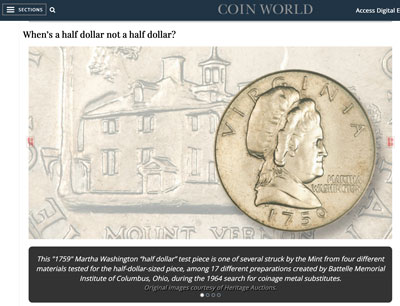
And each coin bore the same portrait of Martha Washington.
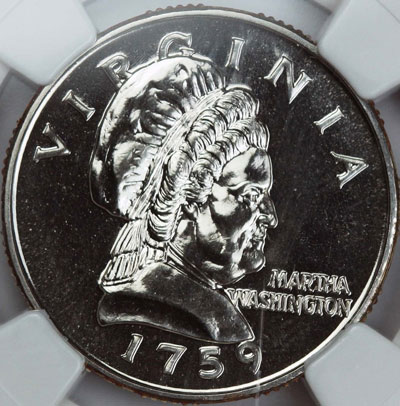
Designed by U.S. Mint Sculptor-Engraver Edward R. Grove, this universal obverse design depicts Mrs. Washington facing right with the legend martha washington. The inscription virginia appears above, with the date 1759 along the bottom rim representing the year she married George Washington.
The coins also bore a universal reverse by Philip Fowler, which depicts Mount Vernon and bears the inscription home of the Washington family.
However, the coins bore no legal tender markings. They did not include a denomination or the traditional inscriptions in god we trust or e pluribus unum. They didn’t even include united states of america.
That’s because they were never intended for use in circulation. So those traditional design elements were simply left off the dies.
This isn’t unusual for dies made for experimental coins. They typically omit such standard elements, or else replace them with random jumbles of letters, which is why they are frequently known as “nonsense dies.”
Many of these Martha Washington coin patterns survive, and examples can be found in the Smithsonian’s collection.
A few have even turned up in private hands, delighting those fortunate enough to obtain them.
1982 Martha Washington Pennies
In the early 1980s, the mint once more found itself forced to adapt to rising metal prices. Only this time, it wasn’t silver. It was copper.
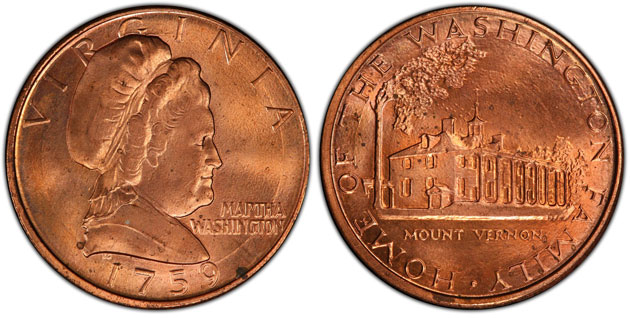
By 1981, the cost of producing pennies threatened to exceed their face value. So the mint urgently tested new alloys, and eventually settled on the copper-plated zinc composition it’s used ever since. And those pattern coins again bore the Martha Washington and Mount Vernon designs that graced the copper-nickel clad patterns of the 1960s.
These 1982 Martha Washington pennies played a vital role in helping technicians verify weight, striking quality and other factors before full production began.
While technically not true cents, these penny-sized pieces add yet another layer of interest for collectors. Especially since a small handful of pieces escaped destruction. They are highly prized for their striking appearance and brilliant, deep-red mint luster, and attract strong interest from collectors whenever they appear at auction.
Martha Washington Nickel Patterns
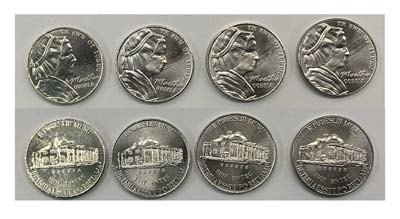
The beloved First Lady also appears on nickel-sized test pieces. Around 1985, the mint struck five-cent patterns using the familiar Grove and Fowler designs.
Cataloged as J-2182, these Martha Washington nickels were struck in the standard 75% copper, 25% nickel alloy. And just like a standard Jefferson nickel, they had a plain edge and weighed exactly 5.0 grams.
So why were they struck?
In this case, it wasn’t to test new alloys or compositions. It was to test production mechanics and machinery like the Schuler coin press.
To date, NGC has certified just nine of these pieces. Experts believe fewer than a dozen specimens survive, placing them among the scarcer Martha Washington patterns and test pieces.
Decades later in the 2010s, newly redesigned Martha Washington “nonsense” dies were used to conduct more nickel tests (J-2210). This time, the mint cancelled at least some of the pieces with a waffle-like pattern after testing.
These nickel-sized pieces reflect the mint’s ongoing struggle to combat rising production costs, while keeping the test coins out of circulation. And they’re a testament to how thoroughly the mint put the Martha Washington design to work.
Martha Washington Coins Lead to Sacagawea Dollars
One of the most compelling chapters in this story involves the Sacagawea dollar.
In the late 1990s, the mint worked on a new dollar coin to replace the Susan B. Anthony dollar, which was never widely accepted in commerce. “Susie B.’s” were often mistaken for quarters due to their similar size – a mistake the mint wanted to ensure wouldn’t happen again.
(Library of Congress).
So this time, it gave the new dollars a distinctive golden hue. The color came from the coin’s chosen composition – a manganese-brass clad outer layer over a copper core. Developing it required extensive testing to ensure compatibility with existing vending and sorting equipment.
So Martha Washington again stepped into the spotlight.
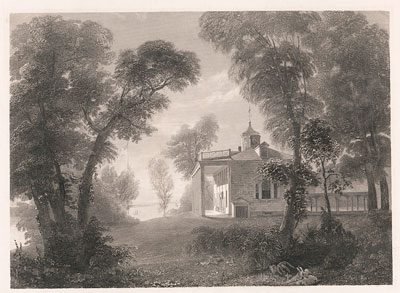
New, dollar-sized dies were created bearing the Martha Washington and Mount Vernon designs, which the mint used to test the new planchets. And the tests were extensive, including both Proof pieces and coins with Uncirculated finishes.
When the Sacagawea dollar debuted, the public was amazed by their bright golden hue. Their successful development owes a quiet debt to those Martha Washington test strikes. And today, that legacy lives on in the Native American dollar series.
The Mint Continues to Strike Martha Washington Coins
As noted above, the mint routinely tests new alloys and compositions, and not just to help offset rising production costs. It also tests them to address supply chain issues and to make it harder to counterfeit U.S. coins.
Sometimes, those tests are conducted with regular dies. However, the mint often relies on nonsense dies instead.
And on those nonsense dies, reverse designs vary. Nickel tests in 2015 featured a Monticello reverse, while cent tests from 2020-2022 bore a Shield cent reverse. But the obverse typically depicts the mint’s favorite First Lady: Martha Washington.
Celebrating America’s original First Lady
Experienced numismatists value Martha Washington pattern coins for their insight into mint operations. They document real technical challenges, and give collectors a rare peek behind the curtain to see how mint engineers solved them.
Of course, their relative scarcity adds to their appeal.
Most of us aren’t likely to acquire Martha Washington pattern coins for our collections. But we can enjoy photographs and descriptions. And perhaps visit them in the Smithsonian’s collection at the National Mall in Washington, D.C.
These Martha Washington coins underscore an important theme in American numismatics: respect for historical figures. By choosing her for its test designs, the mint honored her legacy even as it addressed practical needs.
It’s a thoughtful balance that reminds us why numismatics is such a rewarding hobby. It’s more than just the change in our pockets. It’s the stories that shaped the nation – and history we can hold in our hands.
Until next time,
Happy Collecting!
Sources
Bowers, Q. David, ed. United States Pattern Coins. 10th ed. Atlanta: Whitman Publishing, 2009.
Judd, J. Hewitt. United States Pattern, Experimental and Trial Pieces. 8th ed. Atlanta: Whitman Publishing, 2003.
Smithsonian Institution, National Museum of American History. National Numismatic Collection. Accessed July 2026. https://americanhistory.si.edu/collections/numismatics.
National Museum of American History. National Numismatic Collection Online Catalog. Smithsonian Institution. Accessed July 2026. https://americanhistory.si.edu/collections/object-groups/national-numismatic-collection.
United States Mint. 2024 Biennial Report to Congress. July 2025. Accessed August 6, 2026. https://www.usmint.gov/content/dam/usmint/about/reports/US-Mint-2024-Biennial-Report-to-Congress.pdf.
United States Mint. History of the United States Mint. Accessed July 17, 2026. https://www.usmint.gov/learn/history.
McMorrow-Hernandez, Joshua. “The Martha Washington Experimental Coin Trials.” PCGS News, October 25, 2023. https://www.pcgs.com/news/the-martha-washington-experimental-coin-trials.
Roach, Steve. “Martha Washington Fascinating Pattern Coin.” Coin World, September 29, 2017. https://www.coinworld.com/news/us-coins/martha-washington-fascinating-pattern-coin.html.
Tebben, Gerald. “When’s a half dollar not a half dollar?” Coin World. Accessed August 5, 2026. https://www.coinworld.com/voices/when_s_a_half_dollar.html.
Coin Week. “America’s Rarest ‘What-If’ Coins: Proven Strategies for Collecting U.S. Pattern Coinage.” CoinWeek. Accessed July 2026. https://coinweek.com/americas-rarest-what-if-coins-proven-strategies-for-collecting-u-s-pattern-coinage.
Gilkes, Paul. “U S Mint recommends additional alloy testing for coins.” Coin World, December 19, 2014. Accessed August 6, 2026. https://www.coinworld.com/news/us-coins/u-s-mint-recommends-additional-alloy-testing-for-coins.html.
Gilkes, Paul. “Color changes possible for some U.S. coins.” Coin World, December 30, 2012. Accessed August 6, 2026. https://www.coinworld.com/news/us-coins/color-changes-possible-for-some-u-s-coins.html.
Gilkes, Paul. “Canceled Mint trial strikes found outside of facility.” Coin World, February 23, 2025. Accessed August 5, 2026. https://www.coinworld.com/news/us-coins/canceled-mint-trial-strikes-found-outside-of-facility
Len B. “Martha Washington and the 1792 Half Dime.” Heads & Tails, January 31, 2023. Last updated May 14, 2026. https://blog.littletoncoin.com/martha-washington-and-the-1792-half-dime/.

