
Are Nickels Being Discontinued?
Recently, the United States crossed a historic threshold. After years of debate over rising production costs, the cent was officially retired from circulation 2025.
For collectors, it marked the end of an era spanned more than two centuries. While for policymakers, it was a practical decision driven by economics.
And in both cases, it’s led to questions about the future of another U.S. coin.
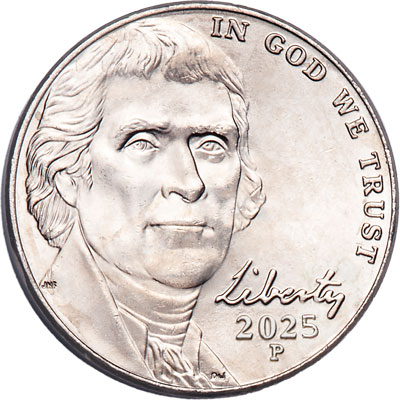
Like the cent, the nickel also costs more than its face value to produce and distribute. According to the U.S. Mint’s 2024 Annual Report, each five-cent coin cost roughly 13.8 cents to mint and distribute.
That’s almost a 20 percent increase from 2022, and a loss of nearly 8.8 cents per coin. A whopping 1.76 times its face value. Not as big a difference as the penny. But still significant. And the gap is expected to grow worse.
Meanwhile, demand for new nickels in circulation dropped by over 44 percent. So, with that in mind…
Are nickels being discontinued, too?
A Coin That Has Endured
While the nickel hasn’t been around as long as the cent, it still has a long and resilient history that spans 160 years.
The first U.S. coins minted in nickel were not five-cent coins, but three-cent pieces. A replacement for silver trimes, they were issued from 1865–1889.
Then, in 1866, the nickel five-cent coins were introduced. Its copper-nickel alloy proved more affordable and durable than the silver half dime. So half dimes were retired seven years later in 1873.
Over the years, the five-cent nickel has seen many designs. First came Shield nickels, which were minted from 1899–1883.
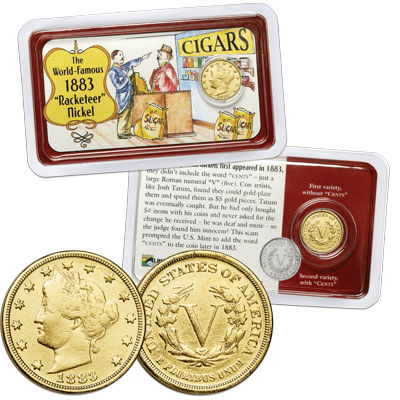
Then came Liberty Head nickels, which were struck from 1883-1913. This series is best known for its infamous first-year “No Cents” variety. It bore only the Roman numeral “V” for the denomination. So unscrupulous con artists like Josh Tatum plated them in gold, and passed the five-cent coins off as $5 gold pieces.
After that came the Indian Head or Buffalo nickels. Issued from 1913–1938, they were an instant success due to their uniquely American designs. And they remain extremely popular with collectors.
However, in 1938, the nickel followed the cent and quarter and adopted a design featuring a U.S. president. The Jefferson nickel has seen no less than six different reverse designs.
You can learn more about the evolution of the U.S. nickel in the Littleton Learn Center’s History of the Nickel page. But for now, let’s stick to the question at hand…
Are Nickels Being Discontinued Next?
Like the cent, the nickel costs more than its face value to produce and distribute. Which means the government – and the taxpayers – lose money on every coin. And with over a billion nickels struck in 2024, those losses really add up.
But while Washington retired the cent last year, it plans to continue nickel production.
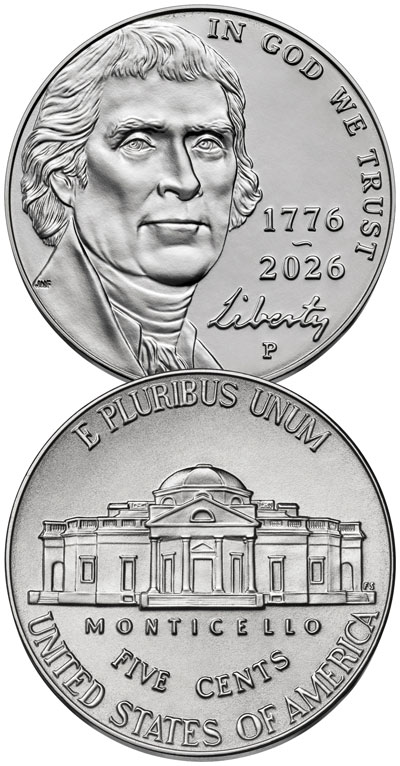
Especially this year. Like other 2026 coins, nickels will bear the dual dates 1776-2026 to honor the nation’s 250th anniversary. You can learn more about the U.S. Mint’s Semiquincentennial coin program here.
Of course, that doesn’t mean the nickel won’t see significant changes…
Changes in Composition Are Coming…
The Treasury Department is exploring different ways to bring nickel costs down to five cents or less per coin. Primarily through alternative compositions.
And this won’t be the first time the nickel has seen such changes.
Since its debut in 1866, most nickels have been made from 75% copper and 25% nickel. But there was one notable exception.
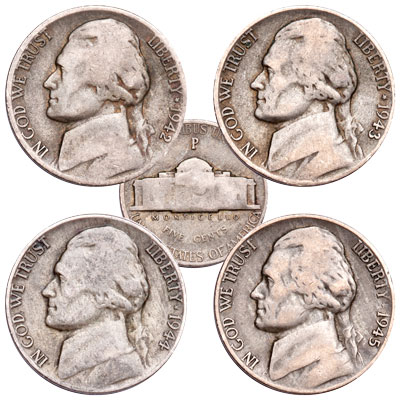
During World War II, copper and nickel were sorely needed for the war effort. So in 1942, Congress ordered the mint to remove all nickel from five-cent coins. As a result, from 1942-1945, nickels were struck in an alloy of 35% silver, 56% copper and 9% manganese.
It was a change that literally helped win the war.
More than 800,000 lbs. of nickel and 1.8 million lbs. of copper that would have been used for coinage was saved. And instead used to make tanks, ships, artillery and aircraft. Including two of my favorites, the P-51 Mustang and the B-29 Superfortress.
These wartime silver nickels had the same weight and appearance of traditional Jefferson nickels. But they are easily identified by the large mint marks above Monticello on the reverse.
And they hold another coinage distinction. They marked the first time the “P” mark was used to identify coins struck by the Philadelphia Mint. Before that, coins struck in Philadelphia simply bore no mint mark at all.
These silver nickels are among the most historic five-cent coins ever issued. Want some for your collection? Littleton currently has a handsome set of 1942-1945 Jefferson Wartime Nickel Set in a Capital Holder. You can find it in their online store while supplies last.
What Will Nickels Be Made From?
One candidate for the new nickel composition is 80/20 cupronickel (80% copper, 20% nickel). This is close to the traditional composition of 75% copper and 25% nickel. The mint has already tested the alloy, and been ready to adopt it since 2022.
However, the mint is testing other alloys, too. Including two versions of C99750TM, a blend of copper, nickel, zinc and manganese. Both match the current nickels for color, weight and durability. As well as conductivity and coinability. And both offer greater savings than cupronickel.
But global supply and demand could present problems. The amount of manganese worldwide is limited, and it’s already in high demand for use in batteries and electric vehicles.
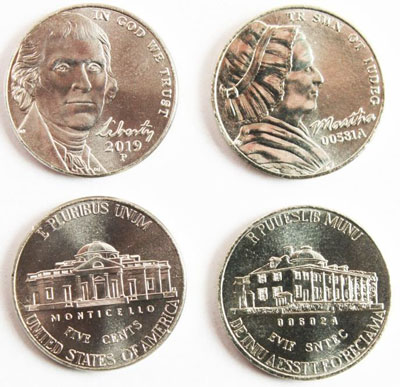
Image Source: U.S. Mint
Still, the mint does use Manganese in both Native American and U.S. Innovation dollars. So it could choose that route. But it wouldn’t be an issue with the cupronickel alloy.
So which will the mint choose?
It’s hard to say. Any of these three alloys would be cheaper to produce than the current nickel composition. But not by much.
The mint estimates all would have production costs greater than 13 cents. That’s less than a single cent per coin in savings, and still 2.5 times face value. Total savings versus 2024 costs? Between $600,00 and $1.4 million.
Since 2015, the mint has lost an average of $70.5 million each year striking nickels. And that’s jumped to $82 million in the past five years. So while $1.4 million is better than nothing, it’s still less than 2% of the savings needed just to break even.
Interesting note: The five-cent coins struck in the new alloys don’t depict Thomas Jefferson. Instead, they feature America’s inaugural First Lady, Martha Washington.
It’s not the first time Martha has graced U.S. pattern coins. But in this case, it might just be a callback to the first official U.S. silver coin: the legendary 1792 half dime.
The Future of America’s Five-Cent Coin

Even if the mint switched the nickel, dime and quarter to one of these new compositions, it only estimates saving between $2.5 and 6.4 million. So I expect the mint will keep testing until it finds the right composition.
The ones I’ve listed above are just a few of those being considered. And the mint does have other options. It could change the nickel’s size as well as composition.
After all, the economic pressures will only increase.
Eventually, something will have to be done. Whether that’s a change in the nickel’s composition… or the denomination is retired from circulation like the cent…
It’s only a matter of time.
Which means, once again, we’ll soon witness another historic change to American coinage. And for collectors like us, that makes collecting U.S. nickels more compelling than ever.
What do you think?
Will we soon see the end of the nickel? Or will it be reborn… minted in a new alloy that brings its costs back under control?
Let us know in the comments!
Until next time,
Happy Collecting!
Sources
2024 Annual Report. United States Mint. December 9, 2024. Accessed February 20, 2026. https://www.usmint.gov/content/dam/usmint/reports/2024-annual-report.pdf
2024 Biennial Report to Congress. United States Mint. July 2025. Accessed February 20, 2026. https://www.usmint.gov/about/reports/2024-biennial-report-to-congress
“Jefferson War Nickel, 1942-1945 : A Collector’s Guide.” CoinWeek. September 29, 2025. Accessed February 20, 2026. https://coinweek.com/5-cent-nickels-jefferson-wartime-nickel-1942-1945/
“History of the Nickel Coin. Littleton Coin Company. Updated February 22, 2024. Accessed February 20, 2026. https://www.littletoncoin.com/shop/Nickels-History
“Steel Cents, Silver Nickels, and Invasion Notes: US Money in World War II” The National WWII Museum. December 4, 2020. Accessed February 20, 2026. https://www.nationalww2museum.org/war/articles/united-states-money-in-world-war-ii
Bessent, Scott. Oversight Hearing of the U.S. Department of the Treasury. 119th Congress. May 6, 2025. Accessed February 20, 2026. https://www.congress.gov/event/119th-congress/house-event/118191?s=1&r=62
Geidroyc, Richard. “Is the Nickel Next to Go?” Numismatic News. Updated May 15, 2025. Accessed February 20, 2026. https://www.numismaticnews.net/is-the-nickel-next-to-go
Gilkes, Paul. “U S Mint recommends additional alloy testing for coins.” Coin World. December 19, 2014. Accessed February 23, 2026. https://www.coinworld.com/news/us-coins/u-s-mint-recommends-additional-alloy-testing-for-coins.html#:~:text=copper%2Dplated%20zinc.-,Additional%20testing,coins%20above%20their%20face%20value.
Roach, Steve. “Martha Washington 1965 pattern coin.” Coin World. September 29, 2017. Accessed February 23, 2026. https://www.coinworld.com/news/us-coins/martha-washington-fascinating-pattern-coin.html


I think the nickel should continue now that it is the lowest value coin for liquidity (penny is gone).
The fact that it’s now the lowest denomination coin in US circulation may be the biggest argument to keep it around, Richard. There’s also talk of keeping it around but changing the composition to something less expensive to produce. We’ll have to wait & see what comes next!
I recently read somewhere that the composition of new U. S. Nickels might be some form of steel; however, the weight, previous experience with the 1943 Steel Cent and mint costs are also items to be considered.
We’ve heard the same things Ron. It’ll be interesting to see what they come up with. Stay tuned!
These six coins have been around for a long time. The medals that make a coin are changing and that changes the cost to make them. And now with people using less coins it would sound reasonable that the nickel would be next in line to be discontinued. So maybe I should start putting my nickels in jars and when the do get discontinued I will have a few pounds to look over.
You’re right Ricky. As a collector, I hope the nickel doesn’t go anywhere, but it does seem like it may be the next to go! It sure will be interesting to see where we go from here coin-wise! Thanks for stopping by.