
Five Fun Facts About National Bank Notes
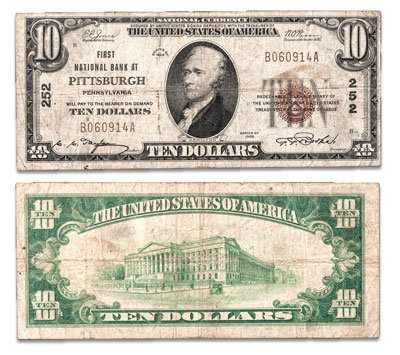
Have you ever walked into a local bank and spotted a framed display of old paper money on the wall?
If so, chances are you were looking at National Bank Notes.
These distinctive currency notes once circulated by the millions across the United States. Issued from 1863 to 1935, they comprise one of the most fascinating – and colorful – chapters in the history of American currency.
Here are five fun facts about these prized paper money issues collectors and history fans still enjoy discovering today. Starting with…
1. National Bank Notes Were Born of the Civil War
National Bank Notes got their start when the nation needed both money and a more reliable currency system.
On February 25, 1863, President Abraham Lincoln signed the National Currency Act (later refined by the National Banking Act of 1864). The new law created a network of federally chartered national banks.
To receive their charter, each bank had to buy United States bonds and deposit them with the Treasury. In return, the bank could issue notes worth up to 90 percent of the bonds’ value.
The system served two purposes. It helped finance the Union war effort by creating demand for government bonds, and it replaced the confusing mix of state bank notes that had circulated before the war.
Those earlier notes varied widely in design and reliability.
By contrast, National Bank Notes carried the backing of the federal government through the deposited bonds. So even if a bank failed, note holders were protected.
Over the next 72 years, these notes were issued by more than 14,000 different national banks across the country and in the territories.
Sheer number of chartered banks aside, assembling a complete charter collection is generally considered impossible, as some chartered banks never issued notes and some that did have no known surviving specimens.
Plus, many notes that survive are locked away in museums, institutional archives or private collections.
But their geographic spread is one reason many collectors chase them so enthusiastically.
2. Every National Bank Note Bears Its Hometown Identity
Unlike today’s uniform Federal Reserve Notes, each National Bank Note announced exactly where it came from.
The note’s face proudly named the issuing bank and the town (or city) in which it operated. As well as the bank’s unique federal charter number – a sequential number assigned when the bank received its charter.
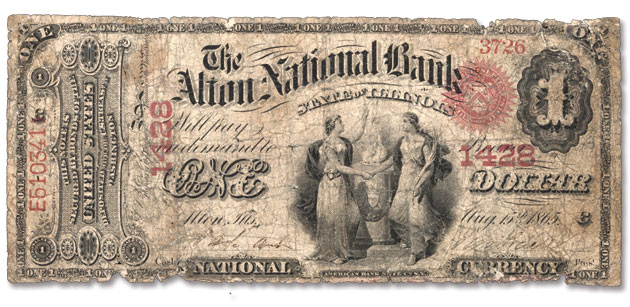
Charter numbers ran from 1 (The First National Bank of Philadelphia) to 14,348 (The Roodhouse National Bank of Roodhouse, Illinois).
Two local bank officers, usually the president and a cashier, signed each note by hand (or later by rubber stamp). And those personal signatures turn the notes into miniature historical documents.growing specialty as research continues to document the hundreds of women who served as national bank cashiers, presidents or assistant cashiers between 1863 and 1935.
Notes bearing low serial numbers were often kept by bank officers as souvenirs. Finding one, especially a crisp, low-numbered note from a small-town bank, is like holding a time capsule of local history.
That’s why some collectors seek out notes from a single hometown bank – and feel it’s well worth the time and effort it can take to acquire them.
3. California Received Gold-Backed National Bank Notes
In the years after the California gold rush, many people on the West Coast preferred hard money – actual gold and silver coins – over paper.
Ordinary National Bank Notes and greenbacks sometimes traded at a discount there. So Congress responded with the Currency Act of July 12, 1870, which authorized a limited number of National Gold Banks.
These banks issued notes redeemable in gold coin, which were printed on distinctive yellow-tinted paper and featured a back design showing a pile of U.S. gold coins.
Only about ten such banks were ever chartered – nine in the Golden State, plus one short-lived institution in Boston that never issued circulating notes.
Between 1871 and 1883 they issued roughly 200,000 notes totaling a little over $3.4 million in face value. However, few of these notes survive today.
National Gold Bank Notes rank among the scarcer varieties within the broader National Bank Note series. As of this article’s publication, only a little more than 600 examples of all denominations are known to collectors – with higher denominations especially elusive.
Nevertheless, they remain a vivid reminder of the West’s long attachment to gold.
4. National Bank Notes Designs Changed with the Times
Like other forms of U.S. paper money, National Bank Notes fall into several series and types that reflect the evolving needs of the banking system.
Collectors usually group them by charter periods:
- First Charter Period (roughly 1863–1882): Original Series and Series of 1875 notes were issued in denominations from $1 to $1,000. These large-size notes feature elaborate historical and allegorical vignettes on the face and reproductions of famous paintings on the back.
- Second Charter Period (1882 onward): Series of 1882 notes appeared in three main varieties – Brown Backs (with a distinctive brown reverse), Date Backs and Value Backs.
- Third Charter Period (1902 onward): Series of 1902 notes first featured red seals, then blue seals with dates and finally plain backs.
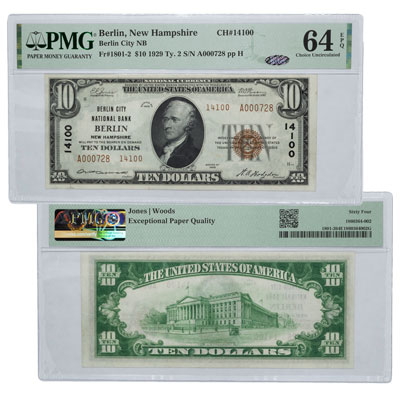
- Small-size notes (Series of 1929): Issued in two types from 1929 to 1935, these notes match the size of modern currency and carry the same familiar portraits used on Federal Reserve Notes of the era.
Each change in design or seal color marks a response to new legislation or the practical needs of the Treasury and the banks.
And the variety makes these notes an endlessly interesting pursuit for collectors.
5. National Bank Notes Invite Hometown Collecting
Because every note names a specific bank and town, National Bank Notes lend themselves perfectly to geographic collecting.
Many people start by looking for notes from their own hometown or home state. Others chase notes from towns with unusual names, from long-vanished banks. Or those from territories such as Alaska, Arizona Territory, Hawaii or Indian Territory.
Some banks issued millions of dollars’ worth of notes over decades. Others issued only a few thousand before closing.
Notes from the smallest issuers can be genuinely scarce today relative to those from major city banks. However, census data compiled by researchers over many years continue to reveal new discoveries.
So their story is still being written one find at a time.
Whether you’re drawn to the ornate large-size notes of the 19th century, the distinctive yellow Gold Bank Notes of California, or a Series of 1929 note from a bank that once stood on Main Street in your own town…
These notes offer a direct link to the communities that issued them.
They remind us that, for more than seven decades, America’s currency carried the names of the places where we lived, worked and did business.
So the next time you see one of those framed displays in a bank lobby – or come across one in a collection – take a closer look at its bank title, the town and the charter number.
You’re looking at a piece of local history that once passed from hand to hand as everyday money.
Want to know more about National Bank Notes?
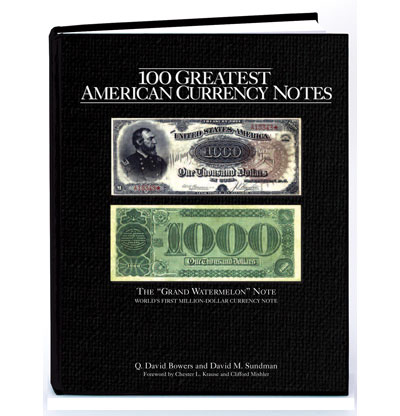
If you’re interested in paper money, you can see some of the most notable and desirable National Bank Notes ever issued in 100 Greatest American Currency Notes by Q. David Bowers and Littleton’s own Chairman, David M. Sundman.
This large book beautifully showcases and tells the stories behind the most famous – and infamous – U.S. paper money issues. Including high-denomination rarities, striking Gold Bank Notes and popular, classic designs like the “Lazy Deuce.”
It’s a wonderful way to explore American paper currency.
Coin Week also has a superb article on National Gold Banks of California, which I discovered while preparing this article for publication. It contains some fascinating facts and magnificent photos of various Gold Bank Notes.
If you’re interested, you can read it here.
Of course, Littleton’s Coin Collecting Learn Center also offers a treasure trove of free resources, from tips and answers to frequently asked questions to beginner guides and checklists to help you keep track of your growing collection.
You can find it at www.LittletonCoin.com/Learn.
And if you’re a collector, Littleton’s online store offers one of the largest selections, with each coin and currency note carefully graded by experts and backed by Littleton’s 45-Day Money Back Guarantee of Satisfaction.
So if you’re a collector, I encourage you to check it out.
Until next time,
Happy Collecting!
Sources
Society of Paper Money Collectors. National Bank & National Bank Note Summary Data. https://www.spmc.org/nb-nbn-summary-data.
Office of the Comptroller of the Currency. “Anatomy of a Banknote.” https://www.occ.gov/about/who-we-are/history/managing-nations-currency/anatomy-of-a-banknote.html.
Bowers, Q. David, and David M. Sundman. 100 Greatest American Currency Notes. Whitman Publishing, 2006.
Huntoon, Peter, et al. Encyclopedia of U.S. National Bank Notes. Society of Paper Money Collectors / National Currency Foundation.
American Numismatic Association. “The Origin of National Bank Notes.” Money Museum virtual exhibit.
Sundman, David. “National Bank Notes of Berlin, NH.” Littleton Coin Company. Accessed August 28, 2026. https://www.littletoncoin.com/shop/National-Bank-Notes-of-Berlin-NH.
Sundman, David. “Postcards and National Bank Notes.” Littleton Coin Company. Accessed August 28, 2026. https://www.littletoncoin.com/shop/Postcards-and-National-Bank-Notes
“National Gold Banks of California: History, Rarity, and the Remarkable Gold Coin Vignette.” Coin Week. August 11, 2026. Accessed August 28, 2026. https://coinweek.com/national-gold-banks-of-california-history-rarity-and-the-remarkable-gold-coin-vignette/

