
Let Freedom Ring!
Three songs written in the 19th century took turns as our national anthem.* But only one featured a nod to our most enduring symbol of independence, the Liberty Bell.
While in seminary in 1831, Rev. Samuel F. Smith wrote “My Country, Tis of Thee (America)”. Its first verse paid tribute to the famous carillon in Philadelphia, ending with the words “Let freedom ring.” To celebrate the Semiquincentennial Fourth of July, let’s do a numismatic search-and-find of the iconic Liberty Bell.
Liberty Bell as Privy Mark
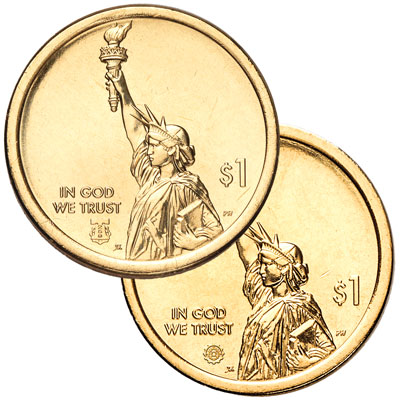
Different from a mint mark, a privy mark is a small, distinctive symbol added to a coin’s design. It might commemorate a special event or theme. Some foreign mints might even use its design as an anti-counterfeiting device. The Royal Mint strikes Great Britain’s annual silver Britannia with a holographic privy mark for that very reason. When tilted, the padlock changes to a trident.
In America, the U.S. Mint has issued a select group of coins with a special privy mark to celebrate the USA’s 250th birthday. Its West Point Mint has issued a dual-dated Proof American Silver Eagle dollar with the Liberty Bell privy mark on the obverse. The numerical 250 is listed vertically on the bell.
All four 2026 U.S. Innovation dollars will include this symbolic privy mark. But on these coins, the Liberty Bell design is laid over the series’ inaugural privy mark – a stylized gear – first seen in 2019.
Liberty Bell as a Coin Motif
Signing off his October 16, 1755 letter to Catherine Ray (Greene) of Rhode Island, Benjamin Franklin wrote, “Adieu, the Bell rings, and I must go among the Grave ones and talk Politicks.” The bell Franklin referred to is the instrument that arrived in Philadelphia in 1752 and installed in the tower of the Pennsylvania State House. Cracked on its first stroke, it was recast and rehung in 1753, the same year construction was finished on the building to house the provincial government of Pennsylvania.
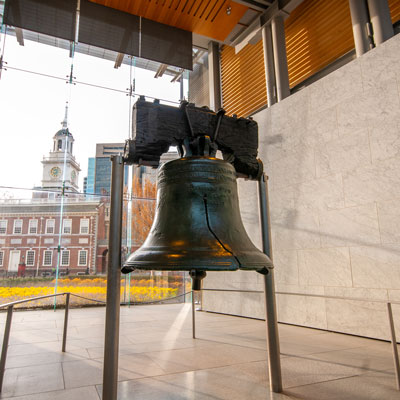
From 1751 to 1764, Franklin represented Philadelphia City as an elected member of the Colonial Assembly. In 1754, the colonists aligned themselves with the British Empire in its fight to oust the French, who were backed by the Indigenous population of North America. The empire won that war, but would lose the next one.
Sent to London to try and negotiate with Parliament over the levy of taxes on its colonies, Franklin, instead, found himself all but physically leading the charge in the War for Independence. Franklin would be the only one of the Founding Fathers to sign all four of our country’s defining documents: Declaration of Independence (1776); Treaty of Alliance with France (1778); Treaty of Paris (1783), and the U.S. Constitution (1787).
What’s a Semiquincentennial celebration if there isn’t at least one Liberty Bell coin?! The third of five dual-dated quarters for 2026 pays tribute to the Declaration of Independence. It’s lead writer Thomas Jefferson is on the obverse. But the reverse shows a refreshing contemporary design for the symbol of freedom.
Interested in a unique challenge coin that puts the Liberty Bell and Benjamin Franklin in physical context? Check out this spectacular offer showcasing Independence Hall, the new name applied to the provincial state house around 1824 when the Marquis de Lafayette, a hero of the American Revolution, visited the United States on his farewell tour. Or, you might prefer this handsome Liberty Bell-shaped coin layered in silver.
What is a FBL?
To date, Franklin is the only non-president to have his profile on a U.S. coin – a silver half dollar struck from 1948 to 1963. Part of that honor included a reverse motif that makes this one of the Liberty Bell designs we’re listing in this numismatic search and find. Designed by mint chief engraver John R. Sinnock, it was finished by Gilroy Roberts after Sinnock’s unexpected death before the coin was ready to be issued.
What Roberts did was add a small eagle to the reverse motif to comply with an 1873 legal requirement that all silver coins with a denomination higher than 10 cents feature an eagle on the reverse. As the Liberty Bell was the dominate image, the tiny eagle image was added to satisfy the legal obligation. It was not a privy mark.
As an aside, the Franklin half dollar’s Liberty Bell design also earned a unique evaluation known as FBL for “full bell lines” from both grading services PCGS and NGC. This criterion refers to a high-quality strike that shows the bell’s seven lines fully uninterrupted.
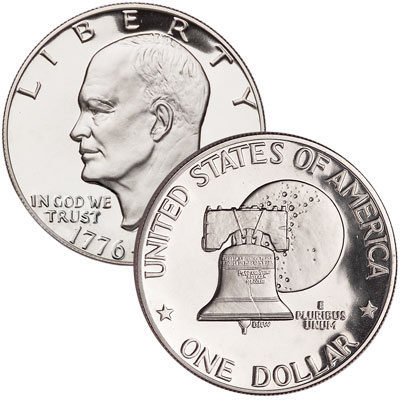
Eight years after the Franklin half dollar series ended, the Liberty Bell made another appearance on a coin’s reverse. This time it was on the Eisenhower Bicentennial dollar of 1776-1976 and was superimposed on the Moon. The Earth’s satellite paid tribute to Eisenhower’s signature on the National Aeronautics and Space Act of 1958, the civilian agency charged with leading U.S. space exploration. The bell’s appearance honored the 200th anniversary of the Declaration of Independence’s signing.
And what’s a coin series for the USA’s 250th anniversary without homage to our beloved symbol of freedom? There’s still time to place an order for Littleton’s exclusive half dollar series that kicked off our entire numismatic commemoration for the SemiQ. But despite its popularity, this is a limited-edition collection, so please don’t wait to order.
Whatever is your memory of a bell that inspires you to collect, you’re invited to share a couple of sentences in the comment section below.
🔔 The other two 19th-century songs were “America the Beautiful”, a poem written in 1893 by Kathleen Lee Bates, a college literature professor, and set to music in 1895, and “The Star-Spangled Banner” written by Francis Scott Key during the 25-hour bombardment of Fort McHenry in Baltimore Harbor in 1814. The 32-month War of 1812, when the British tried to recapture America, formally ended on February 17, 1815 with the Treaty of Ghent in Belgium. Key’s poem-turned-song was accepted as the national anthem in 1931. 🔔
SOURCES
“The Liberty Bell.” Accessed March 23, 2026. https://www.nps.gov/inde/learn/historyculture/stories-libertybell.htm
“Benjamin Franklin to Catharine Ray, 16 October 1755.” Accessed March 23, 2026. https://founders.archives.gov/documents/Franklin/01-06-02-0096


I try to communicate with your compa y yo Buy some coins Buy I didnt received they answer. I was a customer.of.your compa y many Years ago.
Hi Juan, I’m sorry if you haven’t received an answer from us. If you could please email us at info@littletoncoin.com or give us a call, we’ll be happy to assist you. We’re available from 7:30 AM to 9:00 PM et, Mon-Fri by calling 800-645-3122. We look forward to hearing from you! Thanks for stopping by our blog.