
Making the Grade on Coins: Part 1
Want to dip an oar into coin collecting? But the river seems crowded with acronyms like VF, PCGS, PR, ANACS, MS, CAC, AU and NGC?
Let’s paddle about the more frequent coin grades and acronyms you’re likely to see if you are new to collecting. This is the first of two Heads & Tails on basic numismatic grades and how they came about. The second blog will look at paper currency.
Who was Dr. Sheldon? No, not Cooper…
…the senior theoretical particle physicist from the long-running TV series, The Big Bang Theory. Interestingly enough, the show had five scripts involving coins, along with the lead female character who was named Penny.
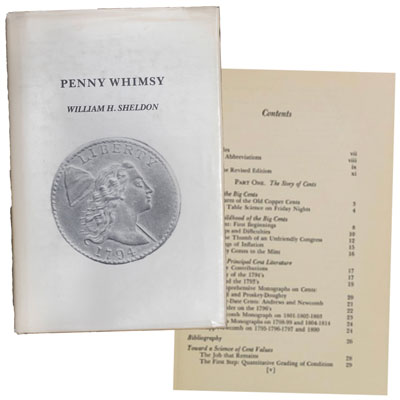
William H. Sheldon, on the other hand, was a WWII-era psychologist and coin collector focused on finding fundamental patterns in life and then creating corresponding systems of identification. His most lasting was assigning numbers 1 through 70 to his collection of early American cents issued 1793-1814, and a subsequent book, Penny Whimsy.
In the chapter titled “Towards a Science of Cent Values”, Sheldon wrote, “A professional numismatist devotes his life mainly to becoming expert at these three matters – recognition of condition, knowledge of rarity, and knowledge of what prices particular coins have brought and will bring in various quarters.”
Sheldon’s system was based on the highest number having 70 times as much value as the lowest one. From our 21st century vantage point, Sheldon was attempting to create order during one of numismatics’ recurring cycles of chaos in agreement over coin grades.
In fact, in 1986, noted numismatist Q. David Bowers, speaking before the Chicago Coin Collectors Club and in his capacity as American Numismatic Association (ANA) president at the time, commented “Grading has been mentioned as a problem in recent times, but a study of numismatic literature will vividly show that a century ago grading was also a problem.”
In the beginning…
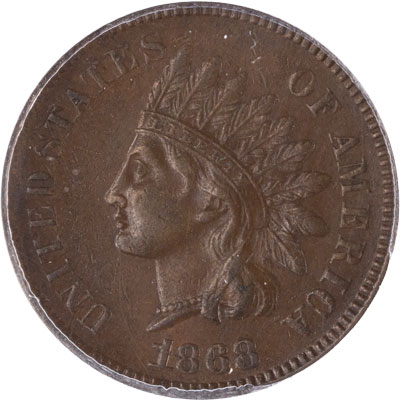
As far back as 1858, attempts were made by coin dealers and collectors to achieve consensus. The adjectives they used, however were rather basic: Good, Fine, Uncirculated. Plus, they served double duty, relating not only to coin wear but also to the strike quality early U.S. Mints were able to produce with the technology of the time.
Today, coin collectors and dealers have settled into a fraternal agreement on coin grades using the Sheldon Scale. Let’s take a look at some of the most-used ones:
- VF = Very Fine; coins showing moderate wear may be assigned a Sheldon value from 20 to 35. Ancient coins often carry a VF designation, or XF for Extra Fine.
- Gem = Uncirculated coins that rate 65-69 on the Sheldon Scale show few imperfections and strong luster.
- MS = Mint State; also referred to as Uncirculated, these coins retain their original mint luster; their Sheldon Scale ranges from 60 to 70, a span many regard as above average.
- AU = About Uncirculated coins may have been used – briefly; their Sheldon value can range from 50 to 58.
- PR = Proof actually refers to manufacturing that produces mirrorlike fields and frosted motifs. It is not about grade.
- Choice Proof = is about grade, or condition, with an expectation the surfaces may have hairline blemishes; Choice Proof coins earn a numerical value between 60 and 70.
- Brilliant Uncirculated = applies to world coins.
Third-party grading services are born
About five decades ago, third-party grading services emerged in a renewed effort to calm disagreements. These independent companies evaluate and assign a grade based on condition and availability, and then encase the certified issue in a protective holder.
In 1973, the ANA launched an authentication service to reduce the counterfeiting of collector coins. It expanded its scope to include third-party coin grading, or a certification service that used the acronym ANACS. In 1990, Amos Media Company, publisher of Coin World, bought ANACS.
In 1986, the Professional Coin Grading Service (PCGS) took the Sheldon Scale to the next step of third-party grading when it popularized protecting a coin’s value in encapsulated, or slabbed, hardshell plastic. Over time, the labels would not just feature grades, but also signatures of coin designers, such as John Mercanti of the original American Eagle silver dollar reverse.
In 1987, the Numismatic Guaranty Company (NGC) joined PCGS and ANACS in the river rapids of coin grading, also offering serious collectors the opportunity to get their purchases authenticated. In this 1909-1932 Saint-Gaudens $20 Gold Double Eagle, both NGC and Littleton’s coin graders were in agreement on its Sheldon grade as a Very Choice Uncirculated 64.
In 2007, Certified Acceptance Corporation (CAC) entered the whitewater to re-establish stricter assessments. Fifteen years later it formed a grading service to which collectors can submit coins they acquire. Here’s an 1879 Carson City silver Morgan with labels from CAC and PCGS, plus Littleton Select.
Littleton Select – what is it?
Glad you asked! A few years back we ran a Heads & Tails interview with Trevor from our grading team. He does a good job explaining the difference between Littleton Select and #2 quality coins in this blog on What’s in a grade?
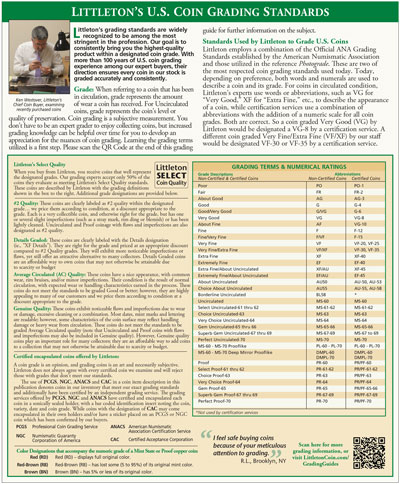
At our Learn Center, we have this handy grading guide that new and established collectors find helpful when assessing the condition of their coins, or those they may want to purchase at a trade show. We recently ran a modified version in one of our catalogs; if you want to subscribe to our catalogs, please click here.
Collectors who are just starting out can also find a modest section devoted to coin grades in the 2026 Red Book.
By this point, you might wonder if coin collectors appreciate grading.
We think this written comment from one in Boise, ID sums up the feedback we receive from our customers on this topic. T.M. wrote: “I like knowing that if I order a certain grade of coin or note from Littleton, that is what I am going to receive.”
Next up – look for the Heads & Tails that explains how paper money is graded.
SOURCES
Albrecht, Leonard; Fahey, Michael; Shafer, Leonard; with preface from the 1977 (1st edition) by Abraham Kosoff. The Official American Numismatic Association Grading Standards for United States Coins, 4th edition. Colorado Springs, CO. 1991.
Alexander, David. “Confronting Sheldon.” Coin World, May 27, 2020. Accessed July 14, 2025. https://coinweek.com/confronting-sheldon/
Bowers, Q. David. “The Coin Hobby As I See It.” Perspectives in Numismatics. Chicago Coin Club. 1986. Accessed July 15, 2025. http://www.chicagocoinclub.org/projects/PiN/tch.html
Giedroyc, Richard. “Grading coins: It hasn’t always been by the numbers.” Coin World. March 10, 1997.
Marotta, Michael E. “Grading terms can illuminate or obfuscate: Flowery adjectives and flexible numbers can be helpful in the long run.” Coin World. September 20, 1999. Sheldon, William H. with Paschal, Dorothy and Breen, Walter. “Penny Whimsy: A Revision of Early American Cents 1793-1814.” Subtitled: “An Exercise in Descriptive Classification with Tables of Rarity and Value.” Quarterman Publications, Inc., Lawrence, MA. 1976.

