
Where Our Nation’s Collective Memory Lives
Curious about a different kind of coin collecting opportunity that honors the founding of the United States of America? Let’s head to Jenkins’ Hill!
“A pedestal waiting for a monument”
With the exception of San Francisco, every major U.S. city photographs as flat. So, with your mind’s eye, envision some 50 acres of hilly pastures along the Maryland side of the Potomac River. You’ll then understand what the French-born, American Revolutionary War veteran-turned-city planner, Pierre Charles L’Enfant, saw when he submitted his design for the Capital City in 1790.
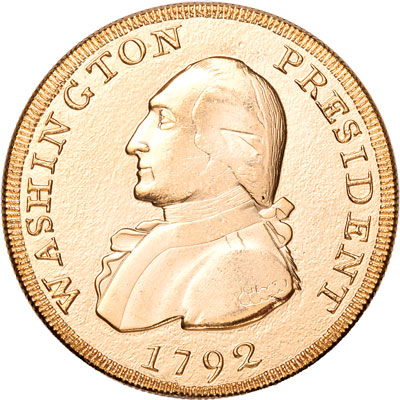
L’Enfant’s blueprint featured wide avenues, landscaped medians, roundabouts for continuous traffic flow, public parks in the shapes of squares and triangles, and the location of federal buildings. He chose the tallest hill, sometimes called Jenkins Heights to this day, for the most important building, the Capitol.
In L’Enfant’s aspirational words, the hill was “a pedestal waiting for a monument.”
On September 18, 1793, President George Washington lay the cornerstone for the monument to representational democracy for which he and other patriots had fought so hard. The square-shaped, neoclassical brick building’s design was drafted by William Thornton. His winning sketch for the Capitol included a “suitable apartment for books” as a dedicated research library for Congress for the new elected officials drafting legislation for a new nation.
On April 24, 1800, President John Adams signed funding legislation to relocate federal services from Philadelphia to Washington, D.C.. Recognizing that legislators needed accessible reference materials to legislate effectively, Adams made sure the bill included $5,000 for the purchase of books. Ordered from London, the volumes represented history, geography, trade, finance, agriculture, science, parliamentary procedures, foundational political philosophy – in all 3,000 volumes, plus maps!
Fahrenheit 451*
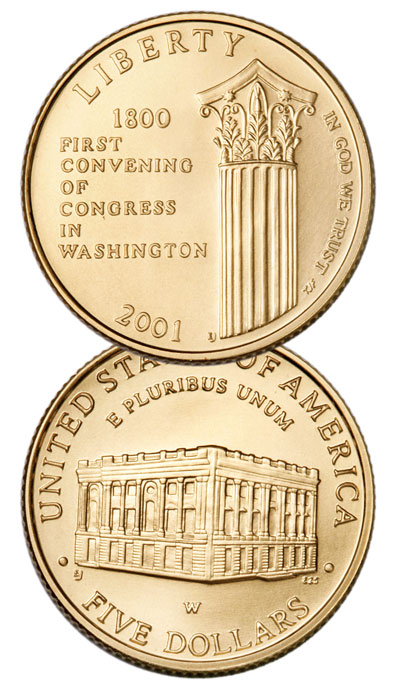
On November 17, 1800, the 6th U.S. Congress convened at its new address. Its Library was put in the Senate Clerk’s Office. Fourteen years and five new states later, with a South Wing built to match the original North Wing, the British Crown tried to regain control of its former colonies. On August 14, 1814, the Redcoats torched the Capitol’s interior – including the Library.
The three-year War of 1812 was economically draining for both sides. It ended in a draw with the U.S. Senate ratifying the Treaty of Ghent on February 17, 1815. To help rebuild the Congressional Library, retired U.S. President Thomas Jefferson sold his nearly 6,500 volume personal collection to the U.S. government. President James Madison signed legislation to acquire Jefferson’s books for $23,950. During the arduous nine years it took to rebuild the Capitol’s interior, Jefferson’s library was housed about a mile away in a hotel, along with Congress.
Architect Charles Bulfinch, who designed the Capitol’s copper-sheathed wood dome, gave the Library a new, soaring space that was 38 feet in height with a bank of windows symbolically facing west. Doors at each end of this central extension connected to the wings. But less than 16 months after moving in, Fate’s flames reappeared. On December 22, 1825, a candle was left burning in one of the Library’s reading nooks. Despite the chilly evening, quick action put out the fire, limiting damage to easily replaceable items.
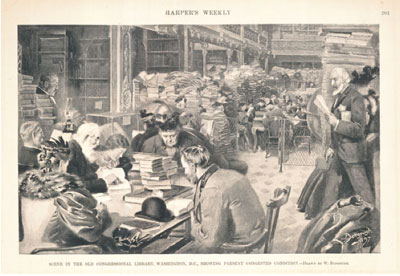
But the Christmas Eve Fire of 1851 had a devastatingly different outcome. Two thirds of Jefferson’s titles were wiped out by the flames from a faulty chimney flue, the result of deferred maintenance. As a result, Congress made the immediate decision to appropriate funds to build a fireproof repository. The two-year-long construction resulted in the press calling it the “largest iron room in the world.”
By the time Illinois attorney Abraham Lincoln was inaugurated for his first presidential term in 1861 – when the Capitol was undergoing construction of a new iron dome – the Library of Congress was again running out of space. It also was experiencing heavy use by lawmakers and a curious public given access to the Library. After all, not yet 100 years old, America was a still-new nation. In the Library, the public could read up on laws, historical documents, new books from new states as they were admitted to the Union, and from subscriptions to domestic and foreign periodicals.
Capitol Hill’s ‘Other’ Dome
Enter Ainsworth Rand Spofford. Here was a man in the middle of the 19th century who read for knowledge! He published books. He sold books. He started a literary society. He was a journalist. Sent from Cincinnati, OH, to Washington, D.C. to cover Lincoln’s inauguration, he switched professions.
Spofford became Assistant Librarian at the congressional repository. During the Civil War, he managed the athenaeum while the Librarian, a medical doctor, tended to Union troops. At war’s end in 1864 and with the doctor not seeking reappointment, Lincoln promoted Spofford to the top spot.
More than an ardent lover of the printed word, Spofford had a vision. He was not unlike the Founding Fathers who envisioned a new world democracy. Nor was he different from L’Enfant, who had a concept for the District of Columbia, or Lincoln, who visualized the emancipation of enslaved men, women and children.
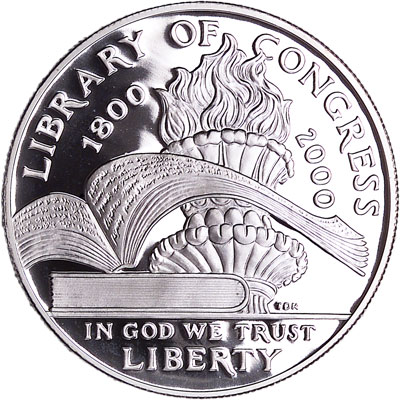
It took dogged determination to make a bonafide national library happen. Part of Spofford’s initiative came from seeing first hand that the Capitol would never have enough space to shelve new books as legislators continued to add new states to the Union. There were 36 in 1864.
The other incentive came from 1870 revisions to the Copyright Act. It required all materials copyrighted in the United States be deposited with the Library of Congress. This revision centralized records management, alleviating federal district courts of the responsibility. But it also required two copies of all published works be submitted to the Library. Where to shelve them?
Spofford saw a new monument could be added on the old Jenkins’ Hill. He started lobbying in 1872. By 1886, Congress agreed to fund a standalone building across from the Capitol on First Street and Independence Avenue. Three years later, construction started. Spofford wanted, and got, a central dome over an octagonal reading room. The dome let light in and the eight aisles of shelves radiating from the circular reading area helped make the 104 miles of shelving easier to manage.
Revealing no small degree of imagination alongside his ever-present appreciation of literature, Spofford christened the new library building “the Book Palace of the American People”. It opened in 1897.
3 Founding Fathers Honored!
The Capitol’s role as an incubator for federal business doesn’t often get attention. Besides the Library, it was the address, in 1801, of the Supreme Court under Chief Justice John Marshall. But leap ahead to 1935 when the federal court had outgrown its rooms in the North Wing. It moved out and across First Avenue, into a new building erected opposite the Library of Congress on East Capitol Street.
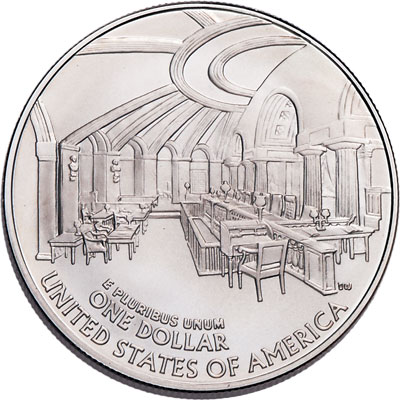
At this time, and even with 104 miles of shelves, the Library was again straining for space. Eventually, Congress would appropriate more than $8 million for an additional 180 miles of shelves in a new building. In 1939, the doors opened on the Art Deco-designed, but unimaginatively named “Annex” across Independence Avenue.
Forty-one years after that, the Library of Congress needed a third building. Another sleek architectural style, this time called Modern Monumental, was used to build a new structure behind the first building on Second Street and Independence Avenue. Described as “commodious” by the Architect of the Capitol’s office, this repository had a mere 59.9 miles of shelves.
But when it was completed in 1980, the three-building compound underwent a sort of christening. Spofford’s 1897 edifice became the Thomas Jefferson Building in honor of the third president whose personal library created the 1815 Library of Congress. The Annex was elevated in stature to the John Adams Building, honoring the second president’s role releasing funds to establish the Library of Congress in 1800.
The James Madison Memorial Building honored not only the lead author of the U.S. Constitution and Bill of Rights, but his January 1783 suggestion that America have a Congressional Library. This modest edifice is also the largest repository of Madison’s original papers as well as home of the Law Library and the Copyright Office.
It’s been a while since I’ve been to the Jefferson Building. Maybe this fall I’ll go with my Showcase. Or maybe a Littleton Coin customer will make it there before me! Let us know!
* Fahrenheit 451 is the degree at which paper burns.
SOURCES
Architect of the Capitol. “History of Capitol Hill.” Accessed April 9, 2026. https://www.aoc.gov/explore-capitol-campus/buildings-grounds/history.
Architect of the Capitol. “History of the U.S. Capitol Building.” Accessed April 9, 2026. https://www.aoc.gov/explore-capitol-campus/buildings-grounds/capitol-building/history
Architect of the Capitol. “Thomas Jefferson Building.” Accessed May 8, 2026 https://www.aoc.gov/explore-capitol-campus/buildings-grounds/library-of-congress/thomas-jefferson-building
Levy, Josh. “Mr. Spofford Goes to Washington.” February 10, 2022. Library of Congress Blogs. Accessed May 8, 2026. https://blogs.loc.gov/manuscripts/2022/02/mr-spofford-goes-to-washington/
Maloney, Wendi. “The Library’s Jefferson Building: 125 Years Old and Loving It.” November 3, 2022. Library of Congress Blogs. Accessed May 15, 2025. https://blogs.loc.gov/loc/2022/11/the-librarys-jefferson-building-125-years-old-and-loving-it/
National Park Service. Capitol Hill Parks. “History and Culture.” Accessed April 10, 2026. https://www.nps.gov/cahi/learn/historyculture/index.htm
Senate Curator’s Office. “Senate Stories: Historical Images of the Library of Congress in the U.S. Capitol.” July 19, 2024. Accessed May 7, 2026. https://www.senate.gov/artandhistory/senate-stories/historical-images-of-the-library-of-congress.htm
“The Senate Vestibule.” Accessed May 8, 2026. https://www.senate.gov/artandhistory/art/resources/pdf/Senate_Vestibule.pdf
“What Sparked the 1851 Fire That Devastated the Collection of the U.S. Library of Congress.” David Bruce Smith’s Grateful American Foundation. Accessed April 17, 2026. https://gratefulamericanfoundation.org/what-sparked-the-1851-fire-that-devastated-the-collection-at-the-us-library-of-congress/

