
Women: In Space & On Coins!
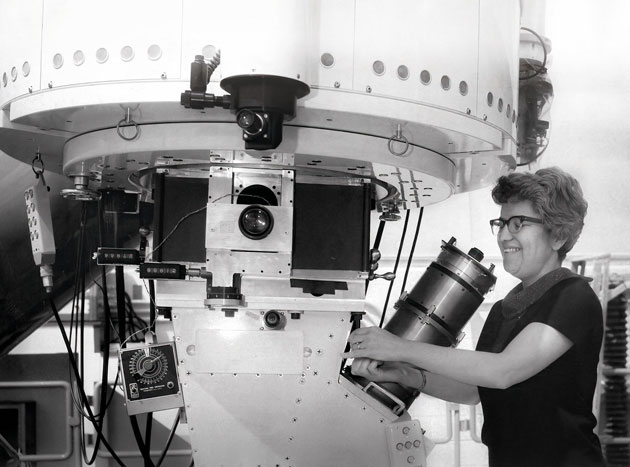
“OMG, she’s a famous astronomer!!!” Pam shrieked in email to my question about her ever hearing of Dr. Vera Rubin. “Are you going to blog about her?”
A member of the Society of Women Engineers, Pam studied astronomy and physics as an undergrad and is part of a fan girl community of women stargazers. Who knew?!
Vera Rubin is the 18th woman trailblazer honored on a U.S. Women quarter, and one of several women whose physics-based achievements led to their coinage commemoration. Come meet them!
Why in Heaven’s Name?
As early as 10, Vera found the night sky and the movement of stars fascinating. Her father, an electrical engineer, helped her build a telescope so she could track meteors. He also brought her to amateur astronomy meetings in Washington, D.C. where they lived. The year was 1938.
In 1944, Vera ignored a high school science teacher who tried to discourage her from pursuing astronomy as a career. She was accepted at Vassar College. Then an all-girls school, it made an early name for itself thanks to pioneering female astronomer Maria Mitchell. In 1865, she went there to teach astronomy – 18 years after discovering a comet. Denmark’s king awarded her a gold medal for being the first in the world to sight a comet using a telescope. It was only two inches in length!
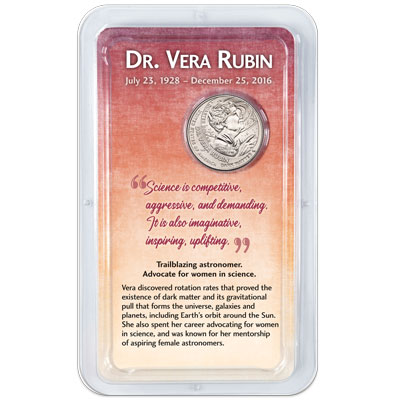
Vera followed in Maria’s footsteps, adding other “firsts” for women interested in astronomy and physics. Vera was the first woman to legally put her hands on the 200-inch Hale telescope at the famed Palomar Observatory, in southern California, because its “hands off” policy at the time deliberately forbade women to use the equipment. The observatory also had no restrooms for women. Showing a sly sense of humor, Vera pasted a skirt on the figure of a man on the door to the only lavatory. The year was 1965.
Vera was also the first female scientist at the prestigious Carnegie Institution’s Department of Terrestrial Magnetism in Washington. The year was also 1965. To appreciate the connection between astronomy and physics, it might help to understand that astronomy uses physics to explain the behavior of stars, galaxies, and other cosmic objects. Physics relies on astronomy to test and refine theories about the universe’s origin and evolution.
But it was Vera’s tenure at the Kitt Peak National Observatory in southern Arizona, started in 1963, that allowed her to be the first female astronomer to do groundbreaking work on galaxy rotation curves. Vera studied the speed at which stars moved in more than 60 spiral galaxies* in order to confirm the presence of dark matter. She presented her data at the International Astronomical Union’s general assembly held in India, generating worldwide interest and excitement. The year was 1985.
Star Gazing
You might be wondering: What does dark matter have to do with me? According to the U.S. Department of Energy website: “Decades of search for dark matter…[resulted]…in new materials, hypersensitive sensors, cryogenics and superconductivity, and algorithms for high-performance supercomputers, quantum computers, and artificial intelligence.” Brilliant!
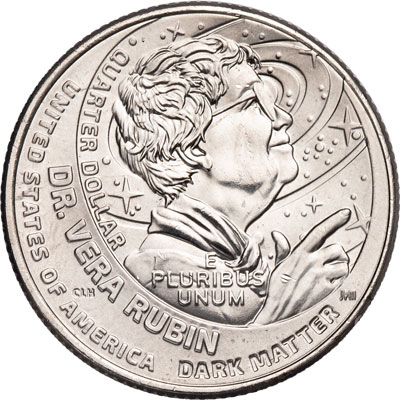
So, Christina Hess of the U.S. Mint’s Artist Infusion Program and Mint Medallic Artist John P. McGraw produced a U.S. Women quarter design showing a profile of Vera Rubin, contemplating the cosmos and framed by a spiral galaxy. Inscriptions included the two most famous words associated with her: dark matter.
A similar design decision honored Annie Jump Cannon, another 19th century-born stargazer like Maria Mitchell. Annie majored in physics and astronomy at Wellesley College. Notably, Annie developed a new system to classify the stars still used today. Like Maria and Vera, she racked up a number of “firsts” for women in science, bridging the lifespan between Maria and Vera. Annie was the first woman to earn a doctorate degree in astronomy from Groningen University in the Netherlands; to receive an honorary degree in science from Oxford University in England, and was awarded the National Academy of Sciences’ Henry Draper Medal of Honor that pays tribute to the pioneer of astrophotography. That year was 1931.
Then there’s this little known-fact about Mary Golda Ross, whose profile includes stars on the Native American dollar that honors her contributions to America’s space programs. Mary’s graduate studies included astronomy. A Tahlequah (OK) Daily Press interview revealed she “…had been dreaming of sending probes and people into space ever since she took her first astronomy classes [but] she didn’t speak of it when she was hired at Lockheed because ‘if I had mentioned it in 1942, my credibility would have been questioned.’”
How They Role
Following Cherokee tradition, Mary made time, even in retirement, to advocate for and mentor Indigenous youth – girls as well as boys – to encourage more Native American participation in engineering.
A mother of three sons but also a daughter, Vera advocated for women in science and was known for her mentorship of aspiring female astronomers. She challenged the men-only Cosmos Club, an exclusive social club for intellectual achievers in the nation’s capital, insisting women be allowed to attend meetings there. The club finally changed its admittance rule. The year was 1988.
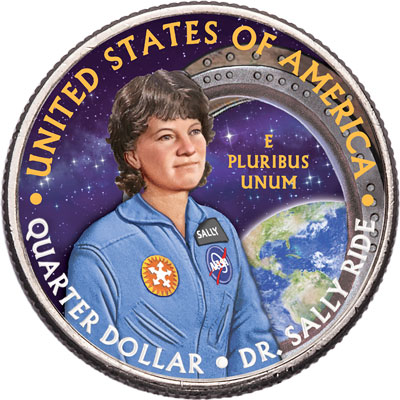
Ironically, five years earlier, astrophysicist Dr. Sally Ride, also honored on a U.S. Women quarter, had become our country’s first female astronaut. Like Vera Rubin, Sally had had a telescope when she was a youngster. Also like Vera, she pursued studies in physics. And like Vera, Sally challenged stereotypes, such as getting NASA engineers to include women locker rooms in their designs for space capsules and to nix the idea that female astronauts needed a make-up kit for orbiting in space. Like many of the women who came before her, Sally paid it forward for the next generation, especially girls, with creation of Sally Ride Science located today at the University of California-San Diego.
And, of all the women cited in this Heads & Tails blog, Sally shared one achievement with another woman also honored on a U.S. Women quarter because she, too, blazed a trail through the sky, Bessie Coleman. In Sally’s rigorous training for spaceflight, she had to learn about fuel, escape velocity, parachute jumping and G-forces – so much so that she decided to earn a private pilot’s license.
So did pioneering African American aviatrix Bessie Coleman, who went to Paris to earn, in 1921, an international pilot’s license after U.S. flight schools denied her admission. Bessie also broke barriers, refusing to perform her barnstorming stunts that made her famous if her black fans were deprived entrance through the same gates as white fans. She also had plans to open her own flight school before her life tragically ended.
Returning to Vera Rubin, during a 1996 graduation speech at the University of California-Berkeley, Vera could have been speaking for all the women who came before and after her when she said, “Science is competitive, aggressive, and demanding. It is also imaginative, inspiring, uplifting.” What do you think? Anyone else having a fangirl moment over Vera and these other stargazers?
*The Milky Way is a spiral galaxy and Earth, and our solar system, are situated in one of its spiral arms. The other well-known spiral galaxy is Andromeda, 2.5 million light years away and the brightest galaxy in our night sky that we can see without a telescope.
SOURCES
A World of Women in STEM. “Mary Golda Ross: Fighter Flight.” February 4, 2022. Accessed May 27, 2025. https://www.wowstem.org/post/mary-golda-ross#:~:text=In%20an%20interview%20Mary%20did,send%20humans%20to%20other%20planets
Alexander, Kerri Lee. “Annie Jump Cannon 1863-1941.” National Women’s History Museum. https://www.womenshistory.org/education-resources/biographies/annie-jump-cannon
Blakemore, Erin. “When Sally Ride Took Her First Space Flight, Sexism Was the Norm.” June 18, 2018; updated May 27, 2025. https://www.history.com/articles/sally-ride-first-astronaut-sexism
Christ, Marion. “Annie Jump Cannon.” American Philosophical Society blog. January 16, 2022. Accessed May 27, 2025. https://www.amphilsoc.org/blog/annie-jump-cannon
Dartmouth College, Department of Physics and Astronomy. “What is Astronomy?” https://physics.dartmouth.edu/undergraduate/astronomy#:~:text=Physics%20and%20astronomy%20became%20even,they%20shine%20for%20so%20long
deGrasse Tyson, Neil & Soter, Steven, Editors. “Vera Rubin and Dark Matter” excerpt from Cosmic Horizons: Astronomy at the Cutting Edge. New York City: New Press, 2000. https://www.amnh.org/learn-teach/curriculum-collections/cosmic-horizons-book/vera-rubin-dark-matter
Scoles, Sarah. “How Vera Rubin confirmed dark matter.” Astronomy. October 4, 2016; last updated May 18, 2023. Accessed May 27, 2025. https://www.astronomy.com/science/how-vera-rubin-confirmed-dark-matter/
U.S. Department of Energy, Office of Science. “DOE Explains Dark Matter.”Accessed June 3, 2025.https://www.energy.gov/science/doe-explainsdark-matter
U.S. National Park Service. “Mary G. Ross.” Accessed May 27, 2025. https://www.nps.gov/people/mary-g-ross.htm
Wilson, Linda D. The Encyclopedia of Oklahoma History and Culture: Ross, Mary Golda (1908‒2008). Oklahoma Historical Society. https://www.okhistory.org/publications/enc/entry?entry=RO041#:~:text=Circa%201944%20Lockheed%20sent%20Ross,missions%20to%20Venus%20and%20Mars

