
Hail Old Glory!

Did you know there were American colonists interested in compromise with the British Empire? They wanted to remain connected but with their provincial governments levying taxes locally instead of the overseas Parliament.
I didn’t know it, either. But in my quest to find the American Revolution’s often overlooked stories, I discovered the visual clue on the flag raised at the start of the war. In three bold primary colors, it merged the kingdom’s crosses for England (St. George) and Scotland (St. Andrew) with the red-and-white stripes representing the 13 colonies. After the British sent soldiers instead of negotiators to Boston, successive flag designs mirrored the collective patriotic shift to political independence and the war to make it happen.
The U.S. flag we recognize now rose in prominence after the Civil War. In the long years of national healing that followed that fraternal war’s end, local observances emerged to honor our country’s unifying emblem. In one oft-cited example, a Wisconsin schoolteacher in 1885 asked his pupils to write essays about what the flag meant to them.
Five Early Flag Designs
In 1949, Congress formalized a national Flag Day tribute so it coincided with the date the Second Continental Congress adopted an official flag for the emerging United States – June 14, 1777. Hawaii’s admission as the 50th state in 1959 called for an update to the banner design we continue to honor.
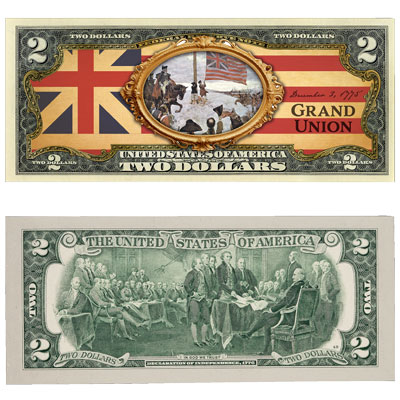
To salute our flag during the USA’s 250th Anniversary, Littleton Coin’s talented artists have colorized five pivotal designs on $2 Federal Reserve Notes. This Flag Day collection illustrates the progression through different periods of American history. Here’s a snapshot of the five collectors will receive:
- Grand Union Flag of 1775 – Combined the British Empire’s religious symbols on the canton (upper left corner) with 13 alternating red & white stripes for the colonies.
- Betsy Ross Flag of 1777 – Featured 13 white stars arranged in a circle against a blue canton and 13 red & white stripes.
- Indian Peace Flag of 1803-1870 – Included an eagle on the canton, his talons holding a peace pipe as was given to friendly Native American nations during westward expansion.
- Centennial Flag of 1876 – Stars on canton arranged to depict 1776 (36 existing states) and 1876 (42 stars included pending status of 6 new states).
- U.S. 50-Star Flag of 1960 – Stars arranged in nine staggered rows of six and five stars after Hawaii admitted.
For numismatists who are philatelists (stamp collectors) and maybe even vexillologists (flag collectors), we’re also offering a Flag Day collection set of 10 historic flag stamps on 1st Day Covers from the Bicentennial. Raised during specific Revolutionary War battles, these banners include the Liberty Flag flown at Ft. Moultrie’s 1776 victory on Sullivan’s Island, SC and the Continental Navy flag featuring an uncoiled rattlesnake – symbol of resistance – on a field of red and white stripes.
Old Glory On Coins
Our symbol of national identity underwent a design evolution before it wound up on a U.S. coin’s obverse in 1916. A.A. Weinman’s now-famous Liberty Walking motif for the silver half dollar featured the flag as a mantle fluttering behind the right shoulder of our beloved icon of freedom. Yet, no circulating currency since has made our federal banner as prominent.
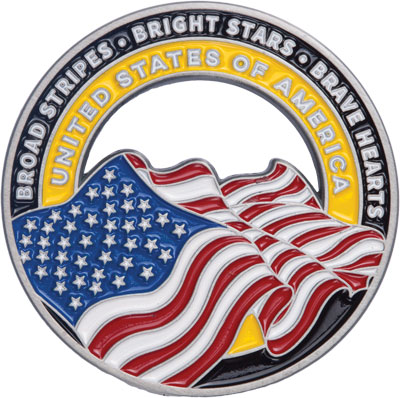
However, in the tradition of challenge coins, Littleton has an ongoing series of custom-minted commemorative medallions that can be used to boost group morale, honor individual service, or traded to build friendships. We have three that are ideal for any Flag Day celebration:
- Don’t Tread On Me relates to the Continental Navy flag stamp referenced in the above section; designed by Christopher Gadsden, it was a radical call to action. The reverse features Benjamin Franklin’s segmented snake and the words join, or die.
- Star Spangled Banner relates to Francis Scott Key’s lyrics written during the ongoing Battle of 1812, when Britain tried one last time to regain control of its former colonies during the 1814 Battle of Baltimore and the bombardment of Fort McHenry (there is also a stamp on a 1st Day Cover in the above noted collection):
- Pledge of Allegiance includes the oath adopted in its current form in 1954 on the reverse; the original pledge was published in 1892.
Philadelphia seamstress Betsy Ross with a flag unfurling from her lap is acknowledged in our popular America 250th collection of half dollars. The final coins for this special Semiquincentennial series will be released in July of 2026. And special for this year, we’re also offering an actual flag with the circular 13 stars on a blue canton from the Besty Ross design!
Researching this blog led me to wonder who coined the nickname “Old Glory”. Turns out it was a Salem, MA sea caption. William Driver received a flag with 24 stars in 1824 when he was appointed master mariner and commander of his own ship, the Charles Doggett. For 20 years, Driver was a merchant seaman, sailing to Gibraltar, China, India, and throughout the South Pacific under this U.S. flag.
“It has ever been my staunch companion and protection,” wrote Driver, who had been born in 1803, the American Revolution still fresh for his parents. “Savages and heathens, lowly and oppressed, hailed and welcomed it at the far end of the wide world. Then, why should it not be called Old Glory?”
Listed as a source below, The Smithsonian magazine has an even more fascinating story about the flag’s survival during the Civil War and the Driver daughter whose donation led to its safe-keeping with the world’s largest museum located in Washington, D.C. If you want something a little more coin-related for your Flag Day collection, check out Littleton Coin’s Old Glory Collectors Tin filled with numismatic collectibles!
We’d love to hear how you celebrate our country’s grand flag – whether you are a numismatist, philatelist or vexillologist. Feel free to post your comments in the section below. Thanks!
SOURCES
Hanna, John. “The reverence for Old Glory that inspired Flag Day arose decades after Betsy Ross sewed her first.” The Associated Press, June 12, 2025. https://www.ap.org/news-highlights/spotlights/2025/the-reverence-for-old-glory-that-inspired-flag-day-arose-decades-after-betsy-ross-sewed-her-first/
Jenkins, Sally. “How the Flag Came to be Called Old Glory: New research may settle a family feud over the origins of an American icon.” The Smithsonian magazine, October 2013. https://www.smithsonianmag.com/history/how-the-flag-came-to-be-called-old-glory-18396/?all.
Soroka, Mark. “How Flag Day Became a National Holiday.” Accessed March 16, 2026. https://nationalflagfoundation.org/how-flag-day-became-a-national-holiday/

