
Looking Back at U.S. Large Cents
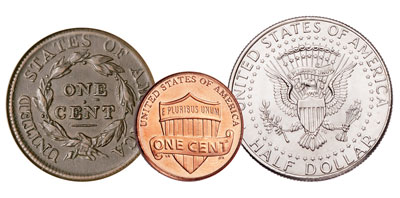
Did you know the first American pennies were almost as big as half dollars?
It’s true.
A Kennedy half dollar measures 30.6 mm in diameter. While early cents measured between 26 and 29 mm in diameter.
By comparison, a Washington quarter measures just 24.3 mm. Modern dollars – like Presidential dollars, Native American dollars and U.S. Innovation dollars – measure 26.5 mm.
And the last cents – Lincoln cents – measured a mere 19 mm. Nearly half the size of their early ancestors.
Because of this, cents are divided into Large Cents and Small Cents. U.S. Large Cents were minted from 1793 to 1857. While Small Cents were minted from 1856 to 2025.
Of course, the cent was retired for circulation in 2025. But the denomination has a rich history dating back more than 232 years. So let’s look back at the many cent types and designs.
Starting with…
Ben Franklin’s Fugio Cent (1787)
U.S. Large Cents were among the first coins struck by the United States Mint in 1793. But their history goes back even further, to 1787.
Four years after winning independence from England, the United States government authorized its first coin: the Fugio cent.
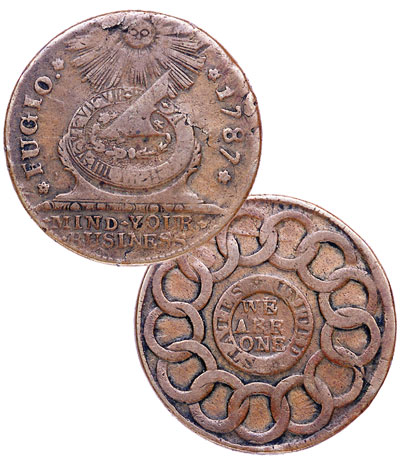
Fugio cents pre-date the U.S. Mint, which wasn’t established until 1792. So these coins are typically classified as Post-Colonial Coinage rather than U.S. Large Cents.
But they measure a whopping 28-29 mm in diameter. So in terms of size, they rank right up there with the largest of the “true” Large Cents.
These coins are sometimes called Franklin cents, because it’s thought they were designed by none other than Benjamin Franklin. And looking at their design, this could certainly be the case. But they’re mostly known as Fugio cents.
That’s because the word fugio – Latin for “I fly” – appears on the obverse, along with a sundial and the inscription mind your business.
Together, the message is clear: Time flies, so mind your business.”
Classic Ben Franklin advice.
On its reverse, the Fugio depicts 13 linked circles, one for each of the original 13 colonies. As well as two inscriptions: we are one and either american congress or united states.
Mr. James Jarvis of Connecticut was commissioned to strike some 300 tons of the copper coins. But he had trouble meeting production deadlines, and some records indicate the government may have cancelled the contract.
It’s unknown exactly how many Fugio cents were struck. They were only issued in 1787, and the mintage is thought to be less than 600,000. But regardless, they never caught on.
And eventually, the government sold its remaining stock at a loss.
Fun Fact: In 1859, “New Haven” restrikes of Fugio cents were made in copper, brass, silver and gold for Mr. Horatio N. Rust using recreated dies.
Flowing Hair Large Cents (1793)

In 1793, the government tried again.
This time, the coins were struck by the newly established United States Mint in Philadelphia. These are the first “official” U.S. Large Cents.
As well as the first coins issued by a U.S. Mint.
Each measured 26 to 27 mm in diameter – slightly smaller than Fugio cents, but still much larger than the later Small Cents. They get their name – Flowing Hair cents, after the image of Liberty with flowing, unbound hair that graces their obverse.
Issued only in 1793, they saw two reverse designs.
The original Chain Reverse was similar to the reverse of the Fugio cent. But vocal critics didn’t see the unbroken chain as an emblem of unity.
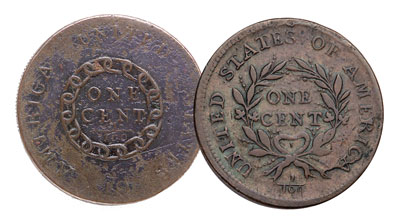
Rather, they condemned it as a symbol of slavery.
So the Chain Reverse was quickly replaced with a new Wreath Reverse. This design featured a laurel wreath and the words united states of america and one cent. And it proved more popular than the Chain Reverse.
But critics still disliked its portrait of Liberty with flowing hair. So just three months later, the mint redesigned the cent yet again.
Liberty Cap Large Cents (1793–1796)
At 29 mm, the third 1793 cent design was a bit larger than the Flowing Hair cent. And in an effort to create a more acceptable design, the mint drew inspiration from the Libertas Americana – a popular 1783 silver medal designed by Benjamin Franklin and Esprit-Antoine Gibelin, and beautifully sculpted by Augustin Dupré.
The obverse still showed Liberty with unbound hair. But it was more composed and “respectable,” and she holds a Phrygian cap atop a pole.”
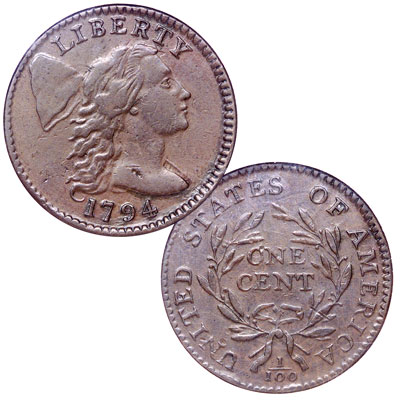
Phrygian caps were an ancient style of soft caps made of felt or wool, with curved, forward-pointing crowns. Originating in Phrygia – home of the legendary King Midas – they were adopted as “the red cap of liberty” during the French Revolution.
The revolutionaries may have confused the caps for pileus caps worn by freed Roman slaves to show their emancipation. But regardless, the association stuck.
And so these cents are known as Liberty Cap cents.
Liberty Cap cents kept the Flowing Hair cent’s wreath theme for the reverse. But the wreath was leaner, and had just one berry on each stem.
The result was a pleasing design that finally calmed the critics. So the new Liberty Cap cents were minted from 1793 to 1796. Until the debut of…
Draped Bust Large Cents (1796–1807)
In 1796, the mint issued a new cent design.
Designed by Gilbert Stuart and engraved by Robert Scot, it was similar to the Liberty Cap cent. Liberty still graced the obverse. But the Phrygian cap was gone. And this time, she wore a ribbon in her hair and drapery across her neckline.
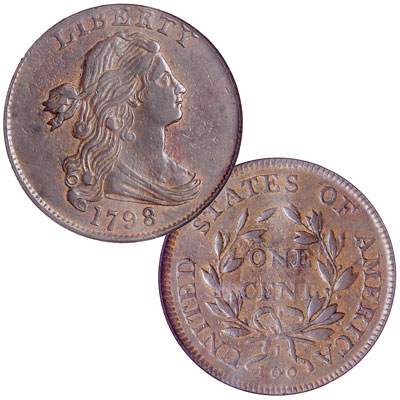
Because of this, these U.S. Large Cents are called Draped Bust cents.
Of course, the changes weren’t limited to the obverse. The reverse changed, too. Instead of a laurel wreath, it featured an open wreath made of two olive branches tied by a bow.
Draped Bust cents proved even more successful than the previous Liberty Cap cents. Over 16 million were minted from 1796 to 1807.
But unfortunately, few were saved.
Most Draped Bust cents were lost to time or the melting pots. And today, these popular large cents are highly prized by collectors.
Classic Head Large Cents (1808–1814)
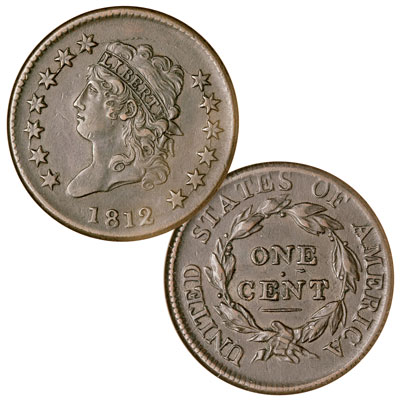
In 1808, Draped Bust cents were replaced by new Classic Head cents.
As with earlier U.S. Large Cents, their obverse features Liberty. However, they depict her facing left, with curly hair held by a headband inscribed liberty.
These cents hold the distinction of being the first time Liberty is shown surrounded by 13 stars, which represent the original 13 colonies. Their reverse is similar to that on previous cents, but with a continuous, or closed, wreath.
Classic Head cents were struck from 1808 to 1814. Due to a shortage of copper, no cents were minted in 1815. And when cent production resumed in 1816, it was with yet another new design…
Liberty Head Large Cents (1816–1857)
When the Liberty Head cent debuted in 1816, nobody imagined it would be the final – and longest-running – series of U.S. Large Cents.
Draped Bust cents had held the previous record, at 11 years. But Liberty Head cents would shatter that by being minted for more than four decades, from 1816 to 1857.

However, that doesn’t mean the series didn’t have design changes. Far from it.
Most were minor tweaks to the number of stars, or the size or style of numbers in the date. But a few were extensive enough to divide series into three major types.
The first type of Liberty Head cents features a mature Liberty wearing a coronet, with a ribbon holding her long hair in a bun. Known as Coronet or Matron Head cents, they were minted from 1816-1835.
In 1835, the Matron Head was replaced by the Modified, or “Young Head” design. These bore a more youthful depiction of Liberty. She still wore a coronet, and her long hair was still in a bun. But it was now held by either a ribbon or a beaded cord.
From 1839 through 1857, Liberty’s hair was shown more tightly braided into a bun held by two beaded cords. Because of this, they’re called Braided Hair cents.
Braided Hair cents were the third and final type of Liberty Head cents. As well as the last of the U.S. large cents. Rising copper prices made the coins less cost-effective to produce. And so they were replaced by new, smaller cents in 1857.
Which U.S. Large Cents are your favorite?
Next time, we’ll look at the many Small Cent designs. Until then, which of the U.S. Large Cents do you find most appealing?
Myself, I love the history and uniqueness of Franklin’s Fugio cent. But when it comes to overall design appeal, I’d have to choose the Draped Bust.
But that’s me. I want to know what you think.
Do you have any favorites? And what do you think about the decision to retire the cent?
Let us know in the comments!
Until next time,
Happy Collecting!
Sources
S., Kierstin. “The End is Here! U.S. Mint Finishes Penny Production After 232 Years.” Heads & Tails by Littleton Coin Company. November 13, 2025. https://blog.littletoncoin.com/final-us-cent-has-been-struck/.
“U.S. Cents.” Littleton Coin Company. https://www.littletoncoin.com/shop/Cents-History. Accessed December 9, 2025.
B., Len. “Thomas Jefferson’s Coin Collection, Part 2.” Heads & Tails by Littleton Coin Company. Last Updated September 30, 2022. https://blog.littletoncoin.com/what-happened-to-thomas-jeffersons-coin-collection/. Accessed December 9, 2025.
P., Helen. “Celebrating U.S. Cents!” Heads & Tails by Littleton Coin Company. Last Updated October 6, 2022. https://blog.littletoncoin.com/celebrating-us-cents/. Accessed December 9, 2025.
P., Helen. “The Look of Freedom.” Heads & Tails by Littleton Coin Company. Last Updated September 16, 2022. https://blog.littletoncoin.com/freedom-cap/. Accessed December 9, 2025.
Wikimedia Commons contributors. “File:Libertas Americana silver medallion 1783.jpg.” Wikimedia Commons. https://commons.wikimedia.org/w/index.php?title=File:Libertas_Americana_silver_medallion_1783.jpg&oldid=1066810782. Accessed December 9, 2025.
Yeoman, R.S. (Garrett, Jeff, Sr. Editor). A Guide Book of United States Coins 2025 (78th edition). Whitman Publishing, 2024
Britannica Editors. “Phrygian cap.” Encyclopedia Britannica. March 5, 2025. https://www.britannica.com/art/Phrygian-cap. Accessed December 9, 2025.
Britannica Editors. “Phrygia.” Encyclopedia Britannica. June 11, 2025. https://www.britannica.com/place/Phrygia.

