
Collecting U.S. Pennies: Small Cents
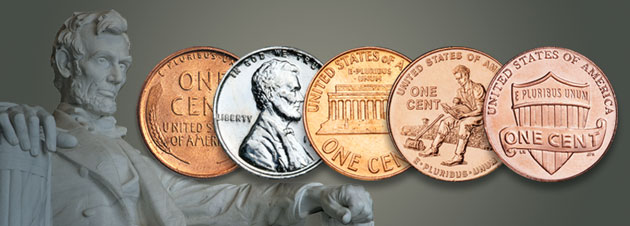
Last year, the U.S. Mint officially retired the cent from circulation. As a result, more and more people are collecting U.S. pennies.
Of course, cents have always been popular among collectors. And with the denomination minted for more than 230 years, you have plenty of options.
Whether you choose to collect a single series or build a complete type set, cents can be surprisingly challenging. But that only makes it all the more satisfying when you add new pieces to your collection.
Struck from 1793–1857, the first cents were much larger than today’s pennies. In fact, they measured 26 to 29 mm in diameter – nearly the size of a Kennedy half dollar!
But as copper prices rose, these coins were more and more costly to produce.
So in 1856, the U.S. Mint unveiled a new, smaller cent. It measured just 19 mm in diameter. And it was struck in copper nickel, rather than in pure copper.
These new cents were considerably less costly to produce. So in 1857, Congress approved the change. And while the penny’s composition changed many more times over the years, its size remained the same.
Because of this, U.S. cents are divided into two main groups. The earlier, bigger cents are known as Large Cents. While the later, smaller pennies are called… you guessed it… Small Cents.
Not long ago, we looked back at the various Large Cent designs. So today, let’s take …
A Look at Small Cent Designs
Since it debuted in 1856, there have been three main series of Small Cents: Flying Eagle, Indian Head and Lincoln Head.
However, Lincoln cents have four subseries. So that gives us a total of six different cent series to choose from.
And frankly, that’s fantastic. Because it makes collecting U.S. pennies as easy or challenging as you want it to be.
If you’re not sure how to go about building your collection, you may find this article helpful. But for now, let’s dive right into the first of these Small Cent designs…
Flying Eagle Cents (1856–1858)
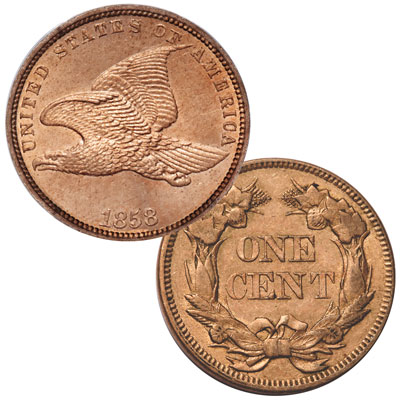
The first Small Cents were the short-lived Flying Eagle cents.
They were minted from 1856-1858. However, those minted in 1856 were patterns struck for Congress. They were only issued for circulation in 1857 and 1858.
Designed by James B. Longacre, Flying Eagle cents are named for their obverse (“heads” side), which shows an eagle in flight. Longacre based it on a design by Christian Gobrecht, which had previously graced the reverse (“tails” side) of 1836-1839 silver dollars.
For the Flying Eagle cent’s reverse, Longacre chose an agricultural wreath of corn, wheat, cotton and tobacco, surrounding the denomination one cent. The wreath design was one he had previously used on the reverses of gold dollars and $3 gold pieces.
Overall, Flying Eagle cents were well received.
But their designs proved to wear down too quickly in commerce. So they were replaced after just two years in circulation.
And today, these popular pennies are scarce and highly sought by collectors.
Indian Head Cents (1859–1909)
The next U.S. cents were also designed by Longacre. Debuting shortly before the Civil War, Indian Head cents were also struck in copper-nickel.
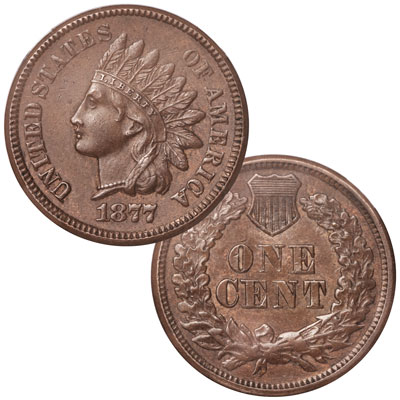
However, just five years into the series, the cent’s composition was changed again. This time, to bronze.
Despite their name, Indian Head pennies do not feature a Native American in their designs. Rather, their obverse depicts Liberty wearing a Native American headdress and a band inscribed liberty. The reverse is similar to the Flying Eagle’s, but features a laurel wreath instead.
Indian Head cents are widely considered America’s most beautiful bronze coins. They were minted from 1859-1909. But after half a century, a new U.S. cent debuted.
And it turned out to be one of the most popular U.S. coins ever minted…
The Lincoln Cent
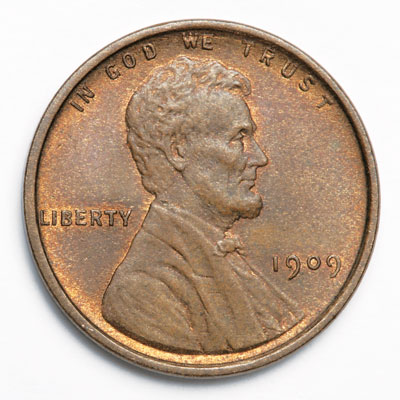
Introduced in 1909 for the 100th anniversary of Abraham Lincoln’s birth, the Lincoln cent was the first regular-issue U.S. coin to feature an American president. As well as the first to depict a real person rather than an allegorical image of Liberty.
And while mintage for circulation ended in 2025, its 118-year run makes it the longest-running U.S. coin series to date.
Designed by Victor D. Brenner, the obverse bears a portrait of America’s 16th president. The design proved wildly popular, and has graced the obverse of every penny issued from 1909-date.
However, the series has seen several design changes. Giving collectors four distinct subseries to collect. Beginning with…
Lincoln Wheat Cents (1909–1958)
The first Lincoln cent reverse depicted two stalks of wheat on either side of the denomination. As a result, these pennies are known as Wheat cents, Wheat Reverse cents or simply “Wheaties.”
These were struck in several compositions, including steel (1943) and recycled brass (1944-1946) during World War II.
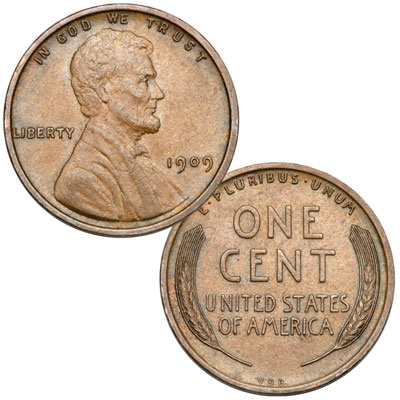
Lincoln Wheat cents initially bore their designer’s initials on the reverse. But critics felt their size and placement were inappropriate, and so the initials were quickly removed. As a result, these first-year “V.D.B.” cents are highly prized by anyone collecting U.S. pennies.
Nine years later, in 1918, Brenner’s initials were restored to the design. But their placement was more subtle. They now appeared on the obverse, below Lincoln’s shoulder at the edge of the portrait.
Issued from 1909 to 1958, Wheat cents were replaced in 1959. But they remain some of the most popular U.S. coins to collect.
Lincoln Memorial Cents (1959–2008)
Lincoln Memorial reverse cents debuted in 1959 for the series’ 50th anniversary and the 150th anniversary of Abraham Lincoln’s birth.
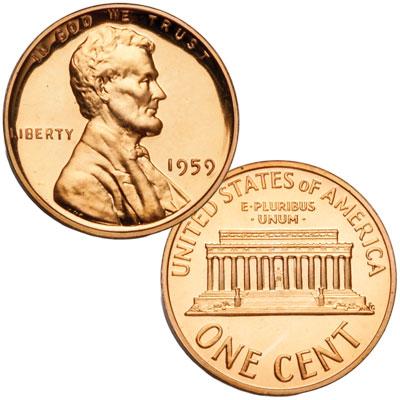
Like Wheat cents, they get their name from their reverse design, which depicts the Lincoln Memorial in Washington, D.C.
Interestingly, Lincoln appears on both sides of the coin. Because, if you look closely, you can see his statue in the center of the Lincoln Memorial.
Memorial cents were minted in an alloy of 95% copper and 5% tin and zinc from 1959 to 1962. Then in 95% copper and 5% zinc from 1962 to 1982. And in 1982, the composition changed again, to copper-plated zinc.
The final Memorial Reverse cents were struck in 2008. Because after 50 years, they were replaced by…
Bicentennial Cents (2009)
In 2009, the U.S. Mint celebrated the bicentennial of Abraham Lincoln’s birth – and the 100th anniversary of the Lincoln cent – with not one, but four new reverse designs.
Known as Lincoln Bicentennial cents, they represent four major stages in Lincoln’s life.
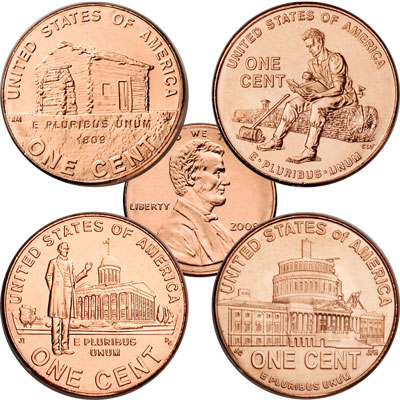
The first shows a log cabin, to represent his humble birth and early childhood in Kentucky. The second, representing his formative years in Indiana, depicts Lincoln reading while on a break from splitting rails.
The third 2009 Bicentennial reverse represents Lincoln’s professional life. It depicts him standing outside the State Capitol in Illinois. And the final reverse honors Lincoln’s presidency in Washington, D.C. with an image of the unfinished United States Capitol Dome.
With just four designs, Bicentennial cents are a fun and easy series to collect. Especially for beginning collectors.
And if you like colorized coins, you’re in for a treat. Because Littleton offers a handsome Proof and Colorized set in their online store.
Shield Cents (2010–Date)
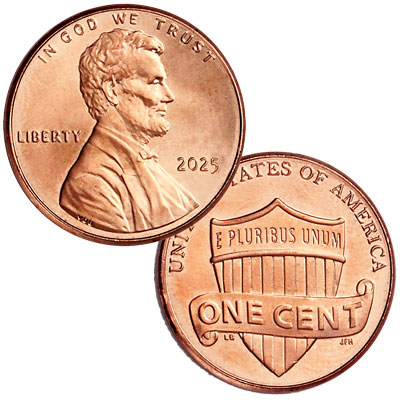
The current – and final – Lincoln cent reverse was introduced in 2010. It features a Union Shield in honor of Lincoln’s tireless efforts to preserve the United States as a single nation.
Because of this, these pennies are known as Lincoln Shield Reverse cents, or simply Shield cents.
The historic design was popular. But soaring production costs forced the mint to end production of circulating pennies in 2025.
Shield cents will continue to be struck and included in special collector sets. But the iconic era of the Lincoln cent has effectively come to an end.
Which U.S. Small Cents are your favorites?
Well, there we have it – the many, marvelous Small Cent designs.
Which do you like best? Are there any you dislike? And what do you think about the decision to retire the cent from circulation?
Whether you’re already collecting U.S. pennies, or simply sneaking a peek at the designs, I’d love to hear what you think. And I’m sure many of our readers would as well.
So don’t be shy. Let us know in the comments!
Until next time,
Happy Collecting!
Sources
S., Kierstin. “The End is Here! U.S. Mint Finishes Penny Production After 232 Years.” Heads & Tails by Littleton Coin Company. November 13, 2025. https://blog.littletoncoin.com/final-us-cent-has-been-struck/. Accessed March 19, 2026
“U.S. Cents.” Littleton Coin Company. https://www.littletoncoin.com/shop/Cents-History. Accessed December 9, 2025.
P., Helen. “Celebrating U.S. Cents!” Heads & Tails by Littleton Coin Company. Last Updated October 6, 2022. https://blog.littletoncoin.com/celebrating-us-cents/. Accessed December 9, 2025.
Yeoman, R.S. (Garrett, Jeff, Sr. Editor). A Guide Book of United States Coins 2026 (79th edition). Whitman Publishing, 2024

