
March is Women’s History Month
No More an Unsung Hero
Camp followers, field nurses, those who enlisted disguised as men – identifying the women who served in the American Revolution is a task for the ages. Thanks to the 250th anniversary of the United States, we’re getting to know one. Polly Cooper of the Oneida Nation in New York is honored on the 2026 Native American Dollar for her contribution.
March is Women’s History Month
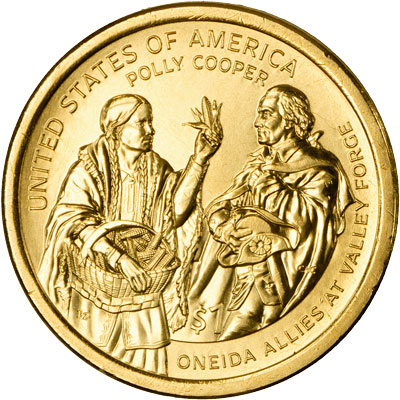
This year’s theme of Leading the Change: Women Shaping a Sustainable Future gives us a prism through which to appreciate the ancient wisdom about farming from Polly’s Indigenous culture. The 2026 Native American Dollar’s reverse places her at the Valley Forge camp along the Schuylkill River in the province of Pennsylvania. She holds a basket as she offers the gift of an ear of corn to General George Washington. Out of respect, he holds his hat in his hand.
To date, the U.S. Mint has struck other coins with corn as part of the one-year-only reverse design on Native American dollars: the 2001 issue depicted the traditional “three sisters” of Indigenous gardening, corn, beans and squash, and the 2014 issue honored Indigenous hospitalityshown the Lewis & Clark Expedition.
Low in carbs and high in protein, Oneida white corn has been nourishing Indigenous people for more than 2,000 years. With Continental troops starving at the bitterly cold start of the winter of 1777, Polly arrived at Valley Forge to prepare corn-based meals such as soup, fine bread and coarse mush. Believed to have been 25 years old at the time, she also used natural medicine to tend their wounds.
Between oral and written history, it’s estimated Polly brought with her as much as 600 bushels of shelled corn. One bushel, or 56 pounds, could sustain an individual for up to 50 days. According to accounts, the military camp figures numbered about 12,000 at winter’s start. Before spring arrived, there were 8,200 troops fit to resume duty.
So, why was Polly Cooper and all that corn in Valley Forge?
The Oneidas Choose Sides
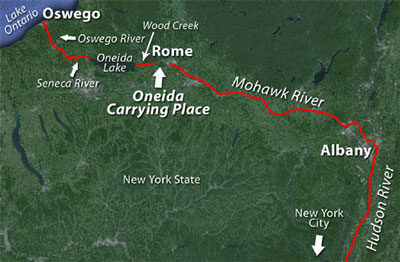
After initially declaring their neutrality in 1775, Polly’s tribe entered the American Revolution in 1777 by warning colonial troops of a pending British attack on Fort Stanwix. For centuries, the nearby Oneida Carrying Place, a six-mile portage connecting the Mohawk River and Wood Creek (near present-day Rome, NY), served as a link in the vital trade route between the Great Lakes and the Atlantic Ocean.
But while the Continental Army successfully repelled the Redcoats, the Oneidas broke with the four other tribes of the historic Haudenosaunee (hoh-den-oo-SHOH-nee) Confederacy as they shared more military intelligence with General Washington. This 2010 Native American dollar honored the confederacy’s Great Law of Peace Belt. It wasn’t until 1794 and a treaty with the new United States that Haudenosaunee Confederacy was reunited.
Polly refused payment for her work at Valley Forge. Oral history suggests she was then gifted an elegant black shawl by Martha Washington, who was known to have been with her husband, along with wives of other officers, at Valley Forge.
Other Native American Women on U.S. Dollars
Polly Cooper is the 17th motif since 2009 when the mint initiated its one-year-only reverse design strategy honoring Indigenous peoples’ contributions to U.S. history. The 2026 Native American dollar was designed by U.S. Mint Artistic Infusion Program (AIP) Artist Beth Zaiken and engraved by Medallic Artist Craig Campbell, who’ve also worked on other coins for the USA’s 250th anniversary.
To date, Polly is one of five Native American women identified on U.S. currency, thanks to these legal-tender issues struck for collectors:
- Hawaii scholar Mary Kawena Pukui graced the 2025 reverse. Her portrait, complemented with symbols of Hawaii’s Polynesian culture, was designed by the AIP’s Christina Hess and digitally engraved by Medallic Artist Phebe Hemphill.
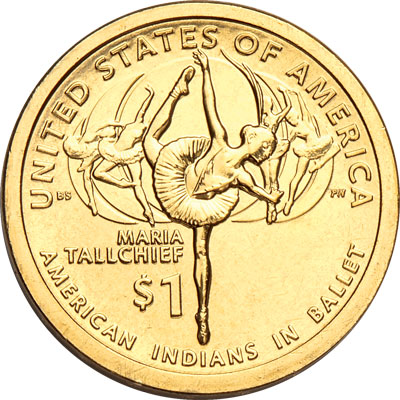
- Prima ballerina Maria Tallchief of the Osage Nation was the lead dancer of the Five Moons shown on the 2023 reverse. Designed by AIP Benjamin Sowards and engraved by Phebe, all five Native American dancers are identified in this Heads & Tails blog.
- Native Alaskan activist Elizabeth Peratrovich of the Tlingit Tribe’s Raven Clan graced the 2020 reverse designed and engraved by Phebe.
- Mary Golda Ross of the Cherokee Nation and first known Native American engineer was profiled on the 2019 dollar. It was designed by AIP artist Emily Damstra and engraved by Medallic Artist Joseph Menna to celebrate Indigenous people in the U.S. space program.
Littleton Coin offers a nice variety of Native American collectibles in addition to traditional U.S. Mint issues: 1 oz. silver “Spirit Dollars” with spectacular designs; 5 oz. copper coins celebrating Indigenous heritage; coin-and-stamp sets, and for children curious to learn more about Native American nations and traditions, detailed coin starter sets issued by the Jamul Nation. Which ones are you collecting? Let us know in the comments section!
SOURCES
American Battlefield Trust. “Polly Cooper.” Accessed January 20, 2026. https://www.battlefields.org/learn/biographies/polly-cooper.
Bruchac, Jesse Bowman. “Still Here: Mary ‘Polly” Palmer (ca. 1753–1844).” September 19, 2025. https://joebruchac.com/blog-posts/f/still-here-mary-%E2%80%9Cpolly%E2%80%9D-palmer-ca-1753%E2%80%931844?blogcategory=Saratoga
Find A Grave. “Six Indian Oneida Scouts.” Accessed January 21, 2026. https://www.findagrave.com/memorial/178494241/six-indian-scouts
“George Washington: An American Paradox.” Accessed January 22, 2026 https://nysm.nysed.gov/exhibitions/george-washington-american-paradox
Lohman, Sarah. “Harvesting the Heirloom Corn That Nourishes the Oneida Nation.” September 26, 2025. https://www.atlasobscura.com/articles/oneida-white-corn-harvest
National Park Service. “Six Miles Shared by Many Nations.” Accessed January 21, 2026. https://www.nps.gov/fost/learn/historyculture/index.htm
National Women’s History Alliance. “Leading the Change: Women Shaping a Sustainable Future.” Accessed January 21, 2026. https://nationalwomenshistoryalliance.org/womens-history-theme-2026/
Okhódayapi, Owámniyomni. “Indigenous Matriarchal Traditions: A Tribute for Women’s History Month.” March 21, 2024. https://owamniyomni.org/2024/03/21/indigenous-matriarchal-traditions-a-tribute-for-womens-history-month/
Wagner, Sally Roesch. “How Native American Women Inspired the Women’s Rights Movement.” https://www.nps.gov/articles/000/how-native-american-women-inspired-the-women-s-rights-movement.htm
Watson, Kandice (Wolf Clan). “Polly Cooper: From Humble Cook to Oneida Icon.” Accessed January 20, 2026. https://www.oneidaindiannation.com/polly-cooper-from-cook-to-oneida-icon/
Women and the American Story. “Life Story: Polly Cooper (Oneida) (dates unknown)” https://wams.nyhistory.org/colonies-and-revolution/the-american-revolution/life-story-polly-cooper

