
Louisiana Purchase Coins: Remembering the Greatest Land Deal in History
Did you know October 20, 2025 marked the 222nd anniversary of the Louisiana Purchase?
Today, it might be hard to believe the 1803 treaty was known for years as “Jefferson’s Folly.” To say it was controversial would be an understatement. Even President Thomas Jefferson felt it “stretched the Constitution until it cracked.” And he’s the one who authorized it.
But it was simply too good a deal to pass up.
After all, it doubled the size of the nation for less than 3 cents an acre. Plus, it averted a brewing war with one of our oldest allies. One who, 25 years earlier, helped us win our independence from England.
One thing I love about collecting coins is their connections to history. Each coin is a tiny time capsule you can hold in your hand.
They bring to life the eras in which they were minted. And they’re often connected to pivotal moments in history. Such as World War II… the first Moon landing… even the Louisiana Purchase.
In a moment, we’ll look at some of the many Louisiana Purchase coins. But first, let’s take a quick look at the historic events behind them…
Securing the Crescent City
Strategically located near the mouth of the Mississippi River, the city of New Orleans has been known by many names.
It’s been called Crescent City. The Big Easy. Even the Paris of the South.
And it’s always played a critical role in U.S. commerce.

Long before New Orleans was an American city, it belonged to Spain. And Spain had granted us “rights of deposit” in the 1795 Treaty of San Lorenzo. This allowed U.S. goods to be shipped down the Mississippi River and stored in New Orleans without export taxes or tariffs.
But in 1801, France acquired the Louisiana Territory in the secret Treaty of San Ildefonso, including New Orleans. And the following year, America’s “rights of deposit” were revoked.
The move crippled western trade and rocked the U.S. economy. Many farmers and merchants relied on shipping their goods via the Mississippi. So in response, many urged the government to seize New Orleans.
Fortunately, Jefferson had a better idea.
He instructed Robert Livingston and James Monroe to approach France with an offer to buy New Orleans and Florida.
Jefferson authorized them to pay up to $9.375 million. If France refused, they were to negotiate back America’s right of deposit.
They succeeded beyond their wildest dreams.
The negotiations took months. And for a long time, it seemed Jefferson’s plan was destined to fail.
But then everything changed.
Napoleon failed to put down the Haitian Revolution. And preparing for a potential war with England not only put him under tremendous financial pressure. It also meant he could not spare troops to secure his western empire.

Knowing this, Livingston said it might be time for America to restore close relations with England. And the calculated remark proved a master stroke. The last thing Napoleon wanted was strong American-English alliance.
So Napoleon did what he did best. He caught everyone by surprise.
He didn’t agree to sell New Orleans and Florida. Instead, he offered up the entire Louisiana territory – a whopping 828,000 square miles of land. It stretched from the Gulf Coast to today’s Canadian border, and the Mississippi River to the Rocky Mountains.
The price? A mere $11.25 million, plus the assumption of $3.75 million in French debt. A total of $15 million. Less than three cents per acre.
In many ways, it was a brilliant move. Napoleon would get much-needed funds for his war efforts. And he would no longer need to defend territory that would likely be lost to the British anyway.
“Jefferson’s Folly”
In America, the Louisiana Purchase was deeply controversial. Federalists pointed out it conflicted with Jefferson’s principles of a limited government.
And while the price wasn’t much by today’s standards, it was more than the young nation could afford. It became known as “Jefferson’s Folly.”
Some even questioned the constitutionality of the purchase – including Jefferson himself. But ultimately, he decided it was in the best interest of the nation.

And he was right.
The Louisiana Purchase is perhaps the largest land deal in history. The United States had previously comprised some 864,746 square miles. “Jefferson’s Folly” added another 828,000 square miles, for a total of nearly 1.7 million square miles.
Overnight, America became one of the world’s largest nations. Only the Qing Dynasty and the Russian, Spanish and British Empires were bigger.
And all that new land would prove to hold more than strategic value. It was also richly blessed with natural resources.
Which was a good thing. Because the nation’s coffers were far from overflowing with cash.
America had to borrow the funds to buy the territory. It took 20 years to pay off the debt, at an interest rate of 6%. That brought the total cost to $23 million – more than half again the original price.
Changing the Course of History

Without a doubt, the Louisiana Purchase changed the course of history. And in time, “Jefferson’s Folly” would be known as “the Land Deal of the Millennium.”
However, the territory wasn’t fully mapped. So Jefferson commissioned Meriwether Lewis and William Clark to explore it… and hopefully find the fabled “Northwest Passage” from the Mississippi to the Pacific Ocean.
Their expedition failed to such a passage. But it did reach the Pacific. And it showed just how vast and rich in resources the new territory was.
This set the stage for America’s Westward Expansion. And as the saying goes, the rest is history.
Coins Related to the Louisiana Purchase
Like many collectors, I love connecting the coins in my collection to historical events. It’s a way of stepping back in time, and bringing history to life.
And when it comes to this historic event, we have a lot of options to choose from.
So let’s take a look at some of the many Louisiana Purchase coins you might add to your collection. Starting with…
Coins of 1803

The first, and most obvious, choices for your collection of Louisiana Purchase coins would be those issued in 1803. After all, that’s the year the purchase was made.
The mint issued eight denominations that year. Six bore the Draped Bust design – half cents, cents, half dimes, dimes, half dollars and dollars. (No quarters were struck.)
The other two – gold $5 half eagles and $10 eagles – featured the Capped Bust design.
Unfortunately, coins of 1803 can be challenging to obtain. Many had low mintages, and most were lost to commerce or melting pots.
But don’t let that discourage you. That just makes acquiring them all the more rewarding. And we still have plenty of other options.
Coins featuring Thomas Jefferson

After coins of 1803, the next logical choice is coins featuring Thomas Jefferson.
It was his plan to buy New Orleans that led to the Louisiana Purchase. He submitted the treaty to the Senate for ratification. And he appointed Lewis and Clark to explore the new territory.
When it comes to Thomas Jefferson coins, you have many to choose from.
First, there are Jefferson nickels. These have been a staple of commerce since they were introduced in 1938. However, they have also always been popular with collectors. So you should have no trouble finding ideal specimens.
The series has seen a few design changes over the years. But the obverses all bear Jefferson’s portrait. And all but four of the reverses depict his home, Monticello.
And these four are perfect choices. Because they are all directly connected to the Louisiana Purchase…
Westward Journey Nickels (2004-2005)
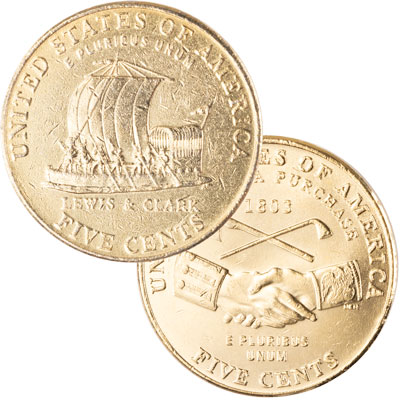
Jefferson nickels of 2004-2005 are known as “Westward Journey nickels.” There were two releases each year, for a total of four coins. And each honors Lewis & Clark’s famous expedition.
The 2004 nickels kept the original Jefferson obverse. But it was paired with two new reverse designs. The first adapted Peace Medals given by Lewis & Clark to the Native American leaders they encountered. The second depicts the custom keelboat Lewis designed for the journey.
The 2005 nickels featured a new, right-facing portrait of Jefferson (shown above). It’s one of my favorite portraits on any U.S. coin, and I wish it had continued after the series. But that just makes these coins even more collectible.
As for the reverse designs, the first 2005 nickel featured the American Bison. It’s not the same design used on 1913-1938 Buffalo nickels. But it does have a similar feel.
The final reverse recalls the expedition’s epic climax, when they reached the Pacific Coast.
Littleton offers a nice selection of Westward Journey nickels in their online store. You’ll find Uncirculated, Proof or gold-plated versions. As well as handsome colorized coins that bring their historic designs to life.

2007 Thomas Jefferson Presidential Dollar
There are plenty more Jefferson coins to choose from. Such as the 1993 Thomas Jefferson 250th Anniversary of Birth commemorative silver dollars. (Fun fact: They were actually minted in 1994.)
But if I had to choose one, I’d go with the 2007 Thomas Jefferson Presidential dollar.
Issued in the first year of the series, it features yet another portrait of Jefferson on the obverse. While its reverse bears the series’ dramatic image of the Statue of Liberty.
And like all Presidential dollars, it includes edge lettering.
The date, mint mark and mottoes e pluribus unum and in god we trust are inscribed along the coin’s edge. Just like on the next coin…

2008 James Monroe Presidential Dollar
No collection of Louisiana Purchase coins would be complete without a 2008 Monroe Presidential dollar.
After all, he helped negotiate the treaty long before he became America’s fifth president.
Like the Jefferson dollar, the coin features edge lettering and bears the series’ Statue of Liberty reverse. While the obverse bears a portrait of Monroe.
Sacagawea Dollars
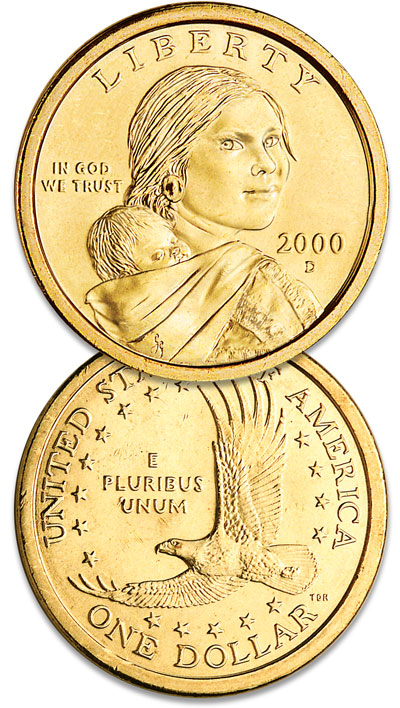
This coin is one of my favorite U.S. coins. Not because it depicts Lewis & Clark’s famous Shoshone guide, Sacagawea.
Or even because it shows her holding her infant son, Jean Baptiste – a distant relative of mine.
For me, it’s the majestic reverse design. It shows a soaring eagle surrounded with wings spread, surrounded by seventeen stars.
Most U.S. coins with stars have thirteen – one for each of the original colonies. So why do Sacagawea dollars have seventeen?
Because that’s how many states there were in the Union in 1804, when Sacagawea joined Lewis & Clark’s expedition.
2014 Native American Dollars
The 2014 Native American dollar is another coin to consider. Like all Native American dollars, it bears the original Sacagawea dollar obverse design.

But this one’s reverse is tied directly to the Louisiana Purchase.
It honors the hospitality Native Americans showed the Lewis & Clark expedition. In the background, NW on a stylized compass reflects the region through which the group traveled.
In the foreground are two figures. The first is a Native American man, who offers a pipe in peace. The other is his wife, who offers provisions of corn, fish, gourds and roots.
2004 Lewis & Clark Commemorative Silver Dollar
The last of the Louisiana Purchase coins I’ll cover here is another commemorative. And once again, it’s tied to Lewis & Clark.
Specifically, the 2004 Lewis & Clark Bicentennial silver dollar.

As the name implies, it was issued two hundred years after President Jefferson sent Lewis & Clark on their epic journey.
The obverse shows the historic pair by a stream, plotting their course. The reverse shows a small version of the Peace Medal they carried. Along with two feathers that represent the Native American nations they encountered.
And like the Sacagawea dollar’s reverse, it features seventeen stars. One for each of the seventeen states in the Union at the time.
Of course, there are other commemoratives you could choose. Like the Lewis & Clark gold dollars issued in 1904 and 1905.
Or the two different 1903 Louisiana Purchase Exposition gold $1 commemoratives. These hold the distinction of being the first official U.S. gold commemoratives. One features Thomas Jefferson, while the other depicts President William McKinley (who authorized the expo).
Let’s not forget Jefferson $2 Bills…
Coins aren’t the only currency you could include in your Louisiana Purchase collection. You can add currency notes as well.
Thomas Jefferson’s portrait has appeared on a variety of currency notes. It graces both Large-size and Small-size Legal Tender Notes. As well as $2 Federal Reserve Bank Notes.

And, of course, the $2 Federal Reserve Notes still issued today.
What would you include?
With so many options to choose from, which would you include in a Louisiana Purchase coins collection?
I’d love to hear. And I’m sure many of our readers would as well.
So don’t be shy. Let us know in the comments!
Until next time,
Happy Collecting!
Sources
The Editors of Encyclopaedia Britannica. “Louisiana Purchase.” Encyclopedia Britannica, July 29, 2025. Accessed September 8, 2025. https://www.britannica.com/event/Louisiana-Purchase.
Greenspan, Jesse. “8 Things You May Not Know About the Louisiana Purchase.” History. A&E Television Networks). Last Updated May 28, 2025. Accessed September 8, 2025. https://www.history.com/articles/8-things-you-may-not-know-about-the-louisiana-purchase
NCC Staff. “The Louisiana Purchase: Jefferson’s constitutional gamble.” National Constitution Center. October 20, 2023. Accessed September 8, 2025. https://constitutioncenter.org/blog/the-louisiana-purchase-jeffersons-constitutional-gamble
Harriss, Joseph A. “How the Louisiana Purchase Changed the World.” Smithsonian Magazine. April 2003. Accessed September 10, 2025. https://www.smithsonianmag.com/history/how-the-louisiana-purchase-changed-the-world-79715124
Wikipedia contributors. “New Orleans.” Wikipedia, The Free Encyclopedia. Accessed September 8, 2025. https://en.wikipedia.org/wiki/New_Orleans

