
Boo!
Do you believe in Ghost Coins?
Something wicked this way comes… and it looks like ghost coins.
Spoken about in whispers, these coins have become something of a legend in numismatic circles. And what better way to celebrate the spookiest season of the year than by uncovering three of the collecting world’s most infamous coins?
The Case of the Missing 1933 Double Eagles
At the beginning of the 20th century, President Teddy Roosevelt believed America’s coins had become… stagnant. The profile of Liberty, a symbol of America itself, had been used on coins for generations and Roosevelt wanted her to have a new look for the 21st century.
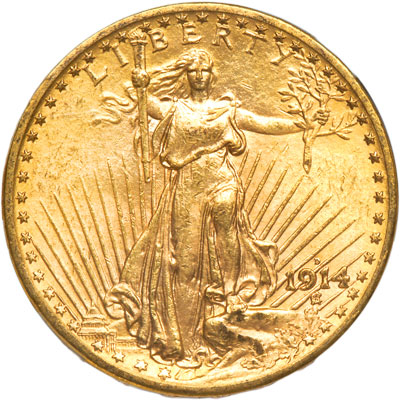
Enter Augustus Saint-Gaudens, the world-renowned sculptor.
His Gold Double Eagle is considered to be one of the most beautiful coins in U.S. mintage history. Which made it all the more difficult to see these coins melted under President Franklin D. Roosevelt’s executive order during the Great Depression. But not everyone followed along with Roosevelt’s order. Enter George McCann, a U.S. Mint cashier.
According to the U.S. Mint, around 20 of the 1933 Double Eagles escaped the melting pot thanks to McCann’s… less than altruistic intentions and connections. In fact, one even traveled all the way to Egypt and right into King Farouk I’s collection. And while the mint was able to track down some of the missing gold pieces, the rest had seemingly vanished into thin air.
Then, in 2003, a Philadelphia family made a startling discovery.
Roy Langbord, the grandson of Israel “Izzy” Switt (a Philadelphia jeweler during the 1930s & 40s), opened his grandfather’s safety deposit box expecting to find a few high-end pieces of jewelry and maybe some gold coins. Instead, he found 10 of the missing 1933 Double Eagles.
Unsure if the coins were legitimate, Langbord went to the U.S. Mint with his find to authenticate them. After confirming that the gold pieces were indeed genuine, the mint kept the coins citing that Switt had stolen federal property.
With no one to confirm or deny Switt’s innocence, what followed was a lengthy legal battle between the Langbord’s and U.S. Mint. Finally, a verdict was reached – the government would retain custody of the Double Eagles.
The Mysterious 1964-D Peace Dollar
By the early 1960s, a coin shortage had gripped the nation. Thanks to silver prices skyrocketing and public hoarding, pocket change was becoming increasingly difficult to find. And in western states like Nevada and Montana, this was a problem for casinos and other cash only businesses that relied heavily on coins.
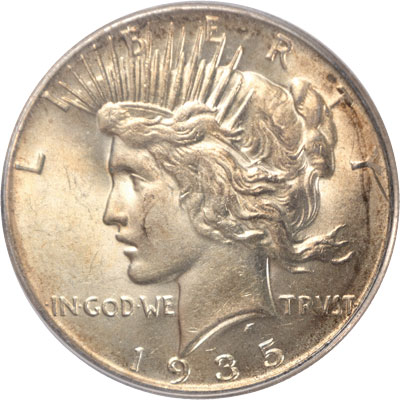
But President Lyndon B. Johnson had a plan. Looking to combat the dwindling supply of coinage being used in daily commerce, Johnson pushed forward a bill that would put silver dollars back into pocket change.
At first, the U.S Mint considered striking 1964 Morgan dollars, then the mint went in a different direction. Instead, the Denver Mint minted approximately 316,106 Peace dollars – including 30 trial strikes. When the coin collecting world heard the news, excitement erupted. Before the coins were even scheduled to be released, coin dealers began putting out ads offering these special silver dollars for just $7.50 each (that’s around $80 today!).
Unfortunately, before they could make their way out of the Denver facility, Congress put an end to the program. They determined that all of the 1964-D Peace dollars should be melted down and never spoken of again. According to then-U.S. Mint Director Eva B. Adams, that’s exactly what happened. And, if you ask around today, not one of these silver dollars has ever been found.
There one minute and gone the next… more than 60 years later, these ghost coins remain one of the biggest “what ifs” for the U.S. Mint.
The Vanishing Act of the 1974 Aluminum Cent
In the same decade that saw the nation’s bicentennial, a piece of coinage mystery, if you will, was struck. The year was 1973 and prices on everything, including the cost of metal for coins, had jumped up over 8%.
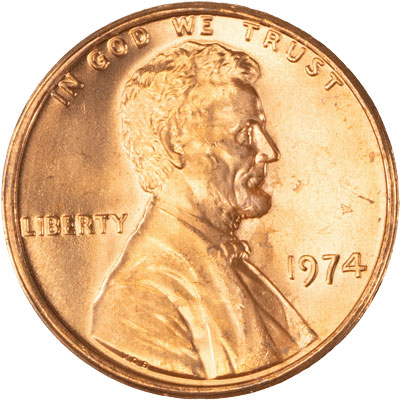
Backed into a corner, the U.S. Mint had to act quickly to continue producing coins. So, they began testing out different materials. Coming out on top? Aluminum.
In preparation, the Philadelphia Mint began to mass produce 1974 Lincoln Head cents in the new metal. But the mint had gotten ahead of itself. Congress hadn’t actually authorized the composition change and required all 1.4 million coins, which had been produced preemptively for 1974, be destroyed.
But whispers of escaped 1¢ pieces haunted the halls of the Philadelphia Mint. Samples of the coin were rumored to exist in the hands of House staff and other officials in Washington D.C. However, only one has ever had its existence proven.
While working at the U.S. Capitol Building, Police Officer Albert Tove came across what he thought was a dime. Although Tove attempted to return the piece to the person who had dropped it, he was told to keep the coin. Making this 1974 aluminum cent the only coin known to be in a private collection.
The real mystery though took place just over 1,700 miles away in Colorado.
Officially speaking, the Denver Mint had not been authorized to strike the 1974 cent in aluminum. But one cent with a “D” mint mark was struck anyway.
For years, the Denver issued cent remained hidden with Harry Edmond Lawrence, the Denver Mint’s former assistant superintendent. But in 2014, the coin was authenticated by PCGS and was in the process of being prepared to be auctioned off.
When the U.S. Mint learned of the coin’s existence, it immediately reacted. Like with the Langbord’s coins, the mint believed that the unsanctioned coin belonged to the government not the family who had harbored it since the 1970s. After a legal battle, the coin’s fate was determined and the Lawrence family ceded ownership to the U.S. Mint.
Spook-tacular Coins
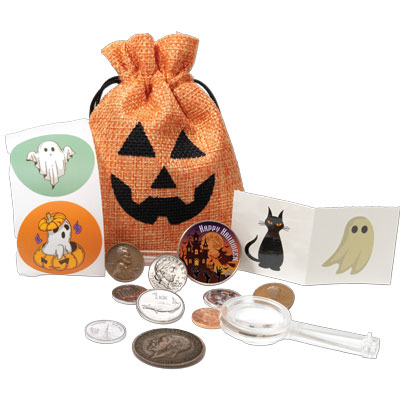
Spooky stuff, right? While we may not have these coins available for you (they are ghost coins for a reason after all!), we do have something just as spook-tacular for you. This Halloween, we’ve put together a hauntingly fun grab bag filled with all sorts of fa-boo-lous finds for your favorite trick or treater.
Until next time, have a happy Halloween all you goblins and ghouls!
Sources:
PCGS. “1933 $20 (Regular Strike).” Accessed August 3, 2026. https://www.pcgs.com/coinfacts/coin/1933-20/9195
Gilkes, Paul. “10 1933 Gold Double Eagles Safe from Fed Destruction.” Accessed August 3, 2026. https://www.coinworld.com/news/us-coins/10-1933-gold-double-eagles-safe-from-fed-destruction.html
Roach, Steve. “What Makes the 1933 Double Eagle so Fascinating?” Accessed August 3, 2026. https://www.coinworld.com/news/us-coins/what-makes-the-1933-double-eagle-so-facinating.html
Morgan, Charles. “The “64-Dollar Question.” Accessed August 5, 2026. https://www.pcgs.com/coinfacts/coin/1964-d-1/507956
Verley, Joshua. “1964-D Peace Dollar.” Accessed August 5, 2026. https://www.money.org/1964-d-peace-dollar-yn-newsletter-december-2023/
CoinWeek. “1974 Aluminum Cent: The U.S. Mint’s Bold Penny Experiment, the Auction That Collapsed, and the Legal Fight That Still Haunts Collector.” Accessed August 10, 2026. https://coinweek.com/1974-aluminum-cent-mint-experiment-auction-legal-status
PCGS. “1974-D 1C Aluminum (Regular Strike).” Accessed August 10, 2026. https://www.pcgs.com/coinfacts/coin/1974-d-1c-aluminum/522941

